
A Signature Honk
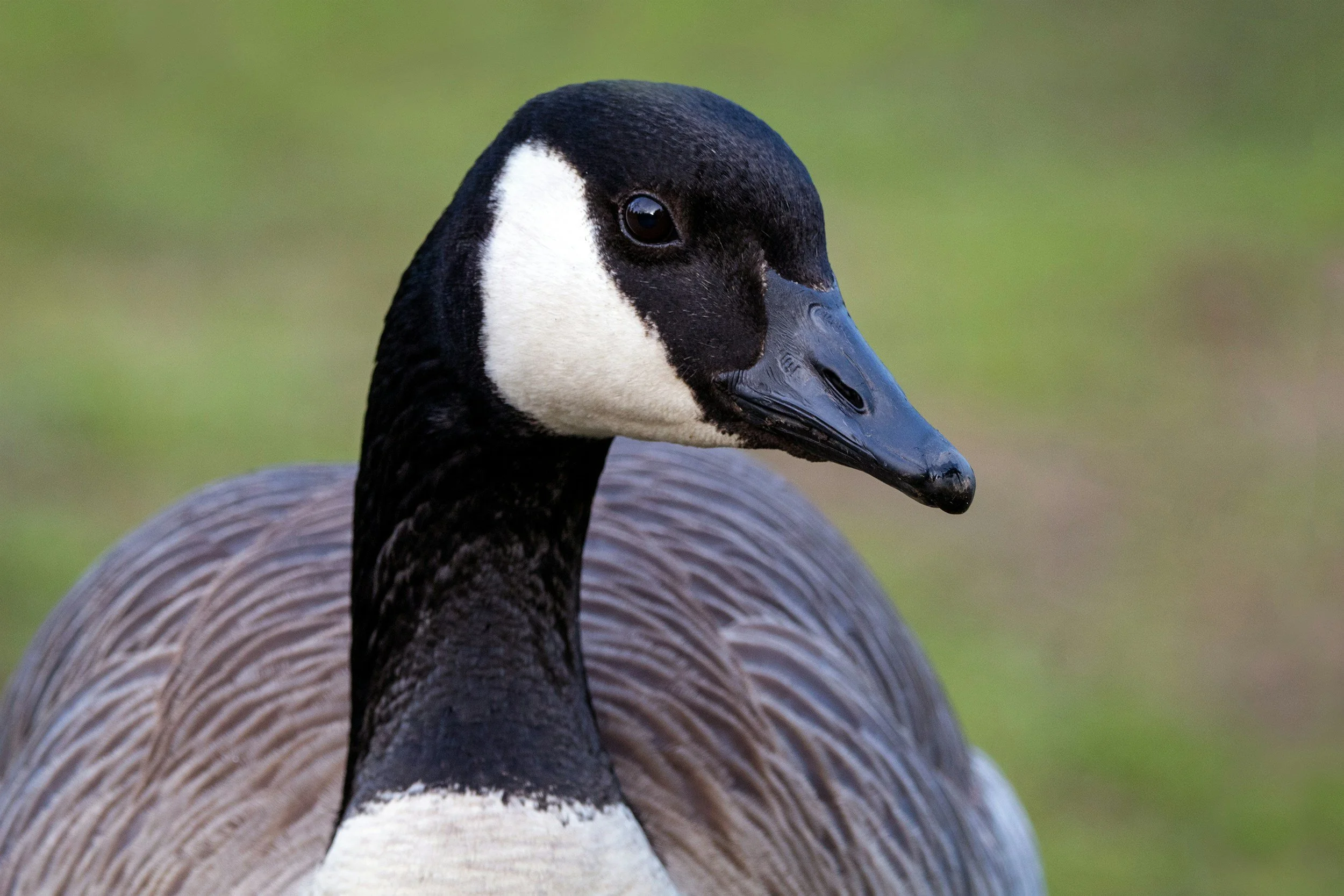
The Canada Goose has made a name for itself as a beloved menace to society. You’ve likely seen this stately species strolling the lakefront trail, refusing to move out of the way for your morning run. Few things are more iconic than the meme of the honking goose, but what do the geese’s calls actually mean?
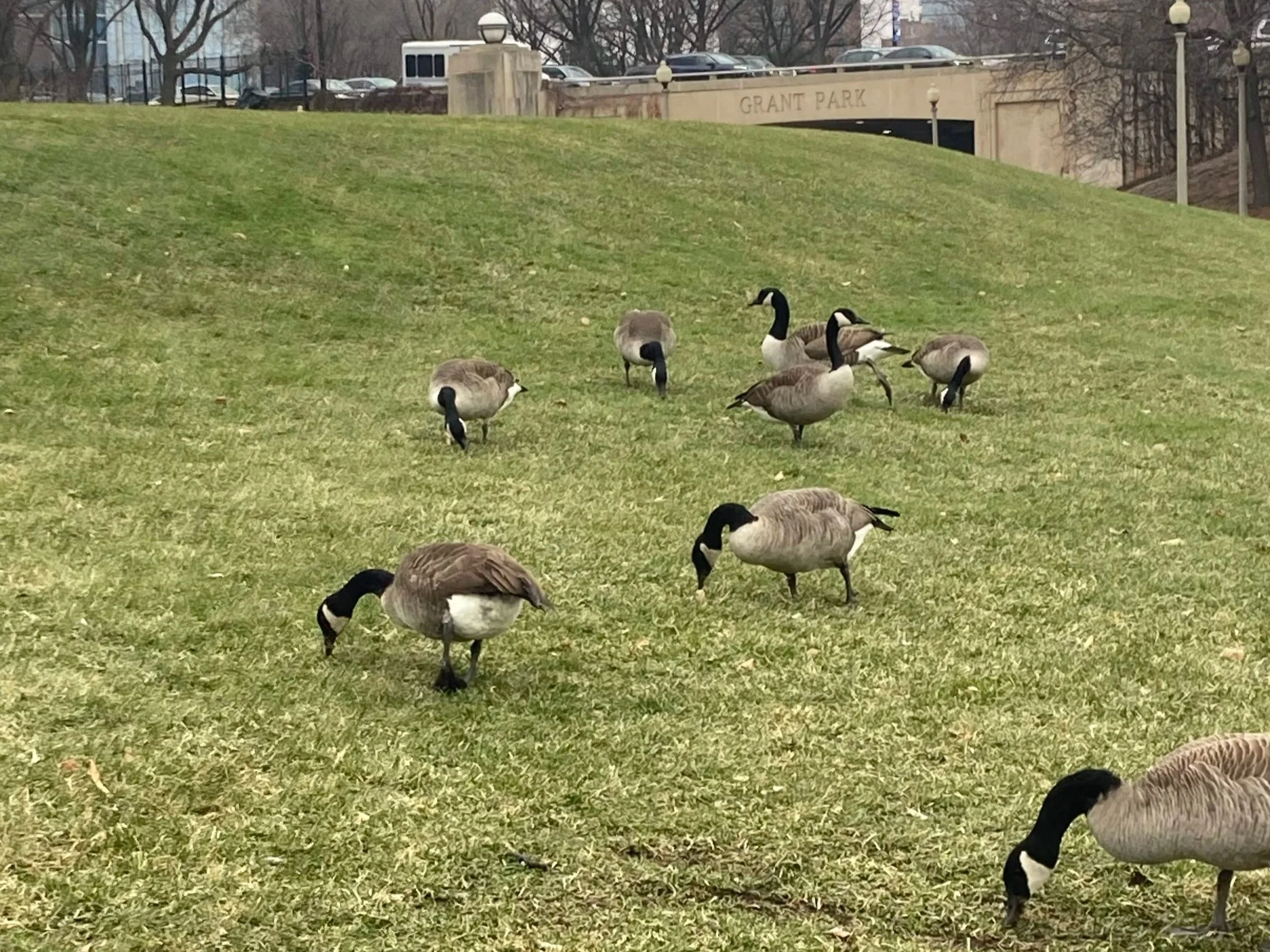
A group of Canada Geese grazing on the grassy hills by Grant Park.
Photo: Susie Xu
The Canada Goose is a highly social species, and at least 13 types of calls have been identified, though there is still some debate. According to researchers, the “deep and resonant” honk is versatile and used in various settings, including to ward off intruders, answering a mate, or as part of a greeting ceremony. If you get too close and a Canada Goose feels threatened, it might hiss at you, as it will at other geese and ducks.
Between themselves, short-range communication is usually done with quieter, shorter grunts. Physical gestures, such as head bobbing and neck pumping, are also important lexicons in their communication. Geese pumping their necks up and down in water are generally quite happy and relaxed, and silent head bobbing while standing straight may mean they are getting irritated.
Socially dominant Canada Geese are more vocal than socially subordinate ones; bigger geese utilize honking more often than smaller ones. There are also a few gender-specific calls. For example, female geese have a special greeting call when they meet each other. The greeting call consists of exchanges of loud and prolonged snoring sounds. Variation also exists between the subspecies.
Humans have utilized goose calls for a few reasons of our own. Some hunters imitate honks and murmurs to lure in Canada Geese, though listening could be more important for preventing geese from ambushing one’s hideout. Philip C. Whitford, a biology professor and pilot, studied Canada Goose vocalization for decades and deciphered a distinct distress call. He experienced geese interfering with flight operations, so he used recordings of the distress calls to deter geese, even turning this into a professional service.
Complicated Backstory
The deterrence of Canada Geese has been a controversial topic, with proponents mostly citing economic reasons. In Chicago, Midway Airport has been working on goose deterrence for years, especially as their numbers have increased recently. Ryan Askren, a biologist, worked with the Airport to deter and track deterred geese. To agitate the geese, they walked or drove toward flocks of geese while clacking boards together. They found very often deterrence is ineffective because the geese simply return later, with the only physiological impact being that deterred geese flew a few more meters than undeterred geese. However, they also found that deterrence can be more effective when the geese are already experiencing distress, such as facing harsh weather conditions. In that case, they are less likely to return to the same spot.
Despite their current ubiquity, Canada Geese have a history of being endangered. As you’ve probably observed, they are particularly drawn to grassy areas with rich water access, especially near lakes or ponds. This allows them to eat the freshly grown grass and have a clear view while protecting their goslings. In addition to grass, their diet also includes grains.
Before lawns, golf courses, and airports, geese had marshes and wetlands. Starting in the late 1800s, wetlands and marshes were drained by US residents for agricultural and residential use. The second Swamp Lands Act, passed in 1850, and the mass production of drainage tiles enabled the draining of wetlands in the Midwest. By 1962, the drainage of marshes in the eastern and central United States had significantly reduced the species’ access to livable habitats, causing the number of Canada Geese to drop sharply. The species was feared to go extinct, and conservationist efforts began.
One subspecies, the Giant Canada Goose, was declared extinct in 1960, but biologist Dr. Harold Hanson, with the help of the Minnesota Conservation Department, was able to trek to Silver Lake where he found the subspecies not only surviving, but adapting quite well to the new environment.
The Canada Goose was also introduced into new habitats by humans. In the 1970s and 80s, they were brought to the mid-Atlantic region for conservation. The species rebounded quickly and abundantly due to being able to successfully hatch in captivity. In 2001, they were taken off the federal list of Endangered and Threatened species. However, they began to pose a risk to local ecosystems by eating a significant amount of wild rice and leaving droppings that cannot be absorbed easily by the ecosystem.
Currently, the US Fish and Wildlife Service observes a special hunting season for Canada Geese, and special hunting licenses are issued by state agencies for property managers and other private owners who demonstrate a need for geese population control and failure to deter Canada Geese by other means.
One Goose, Two Geese
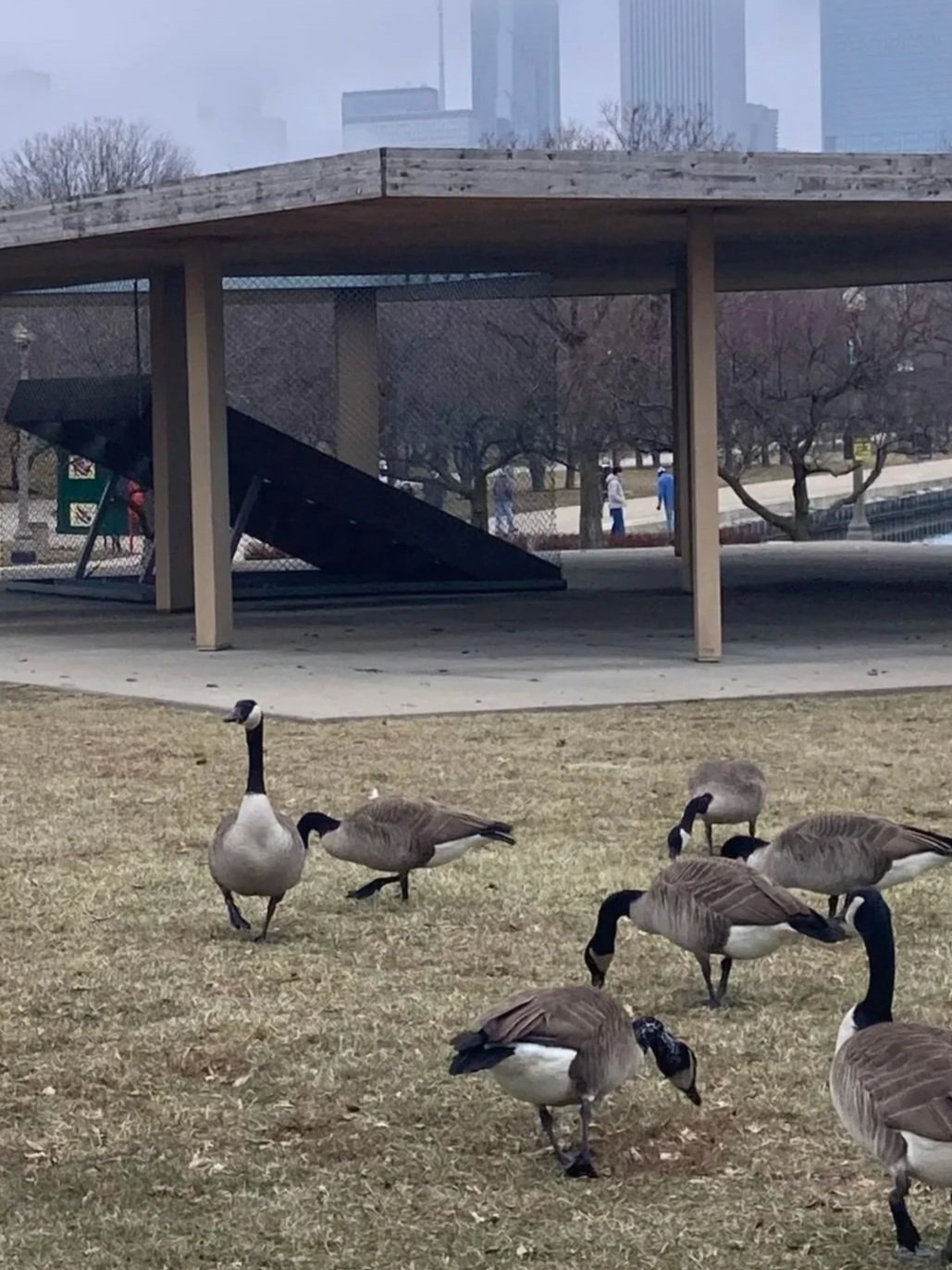
One goose looks into the distance as others graze around her.
Photo: Susie Xu
Canada Geese usually mate for life, but even in pairs, it is not easy to tell the male and female apart. Males, also called ganders, are slightly larger in size. As mentioned before, the females also have their own greeting calls. Morphologically, the ganders tend to have slightly longer necks, and the females appear to have slightly rounder heads. While the white patch around the head is a signature of all Canada Geese, the males have a more pronounced patch and more vibrant dark plumage around the neck and head.
There used to be 11 subspecies of Canada Goose, but in 2004, four of the subspecies with the smallest body mass were combined into a different species, the Cackling Goose. This decision was made largely based on genetic differences, and the name refers to their higher-pitched “cackling”. The Cackling Goose is much smaller and mostly inhabits strictly along the Pacific Flyway. The Richardson’s Goose is the one subspecies that occurs in the Central Flyway, going as far south as Texas for wintering.

A Canada Goose on the right and a Cackling Goose on the left.
Photo by Blake Matheson/Flickr CC

A Richardson’s Cackling Goose next to a Lesser Canada Goose.
Photo by Cathay Sheeter/Flickr CC
The most common subspecies present in Chicago is the Giant Canada Goose (Branta canadensis maxima). This is also the only subspecies known to breed in Illinois, and a lot of them have taken up permanent residence in Chicago. You may be able to see some goslings in the spring. For all Canada Goose subspecies, you can tell a gosling apart from its parents based on its duller plumage and higher frequency wing flapping. Nesting takes about a month, and babies usually can fly about 70 days after hatching. Once goslings reach adulthood, their mortality rate drops significantly. A Canada Goose can live between 10 and 25 years, and the oldest known wild Canada Goose was 33 years old, which was first tagged in Ohio in 1969.
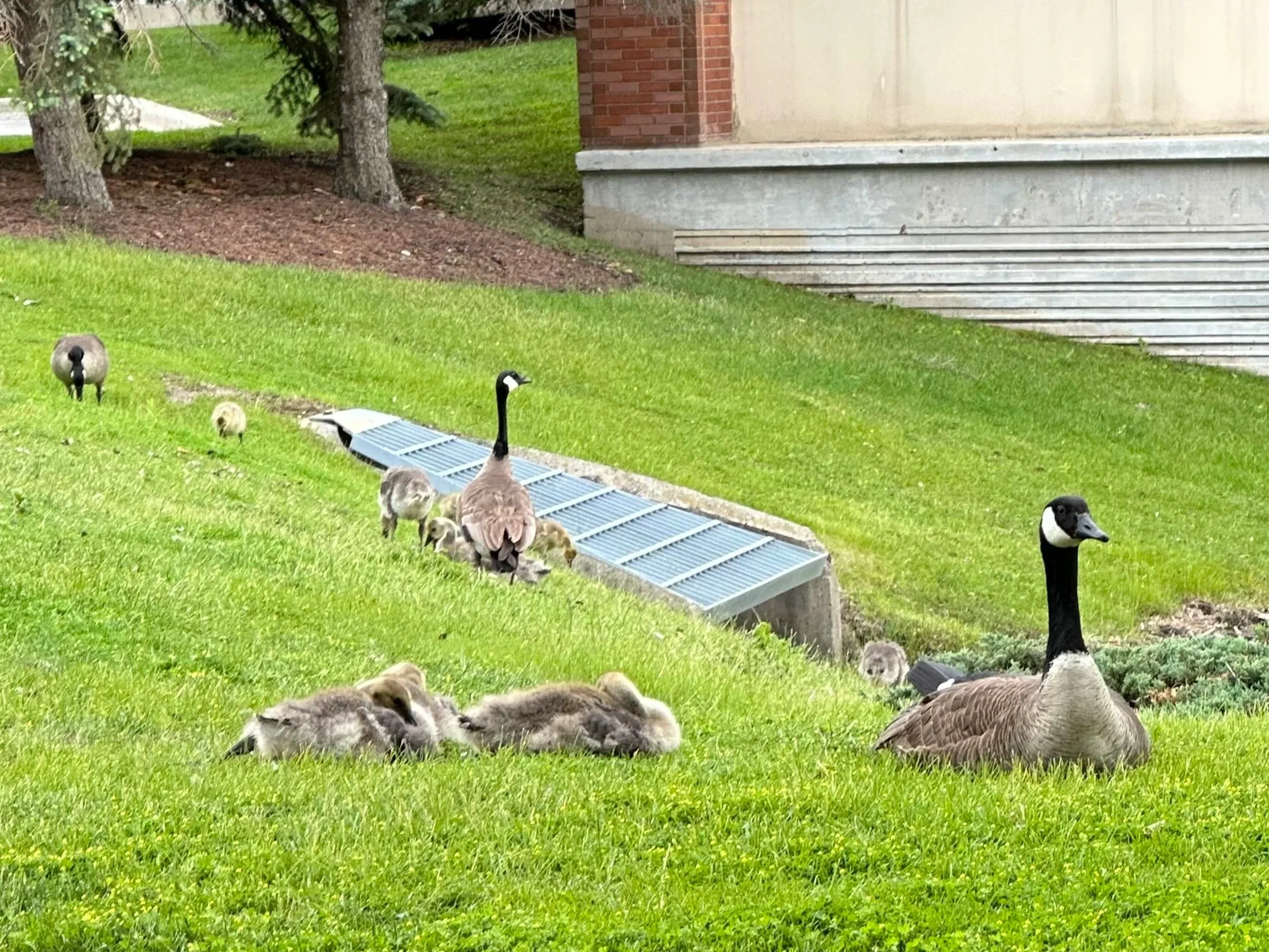
A family of Canada Geese hanging out and grazing.
Photo by Joseph Bruno
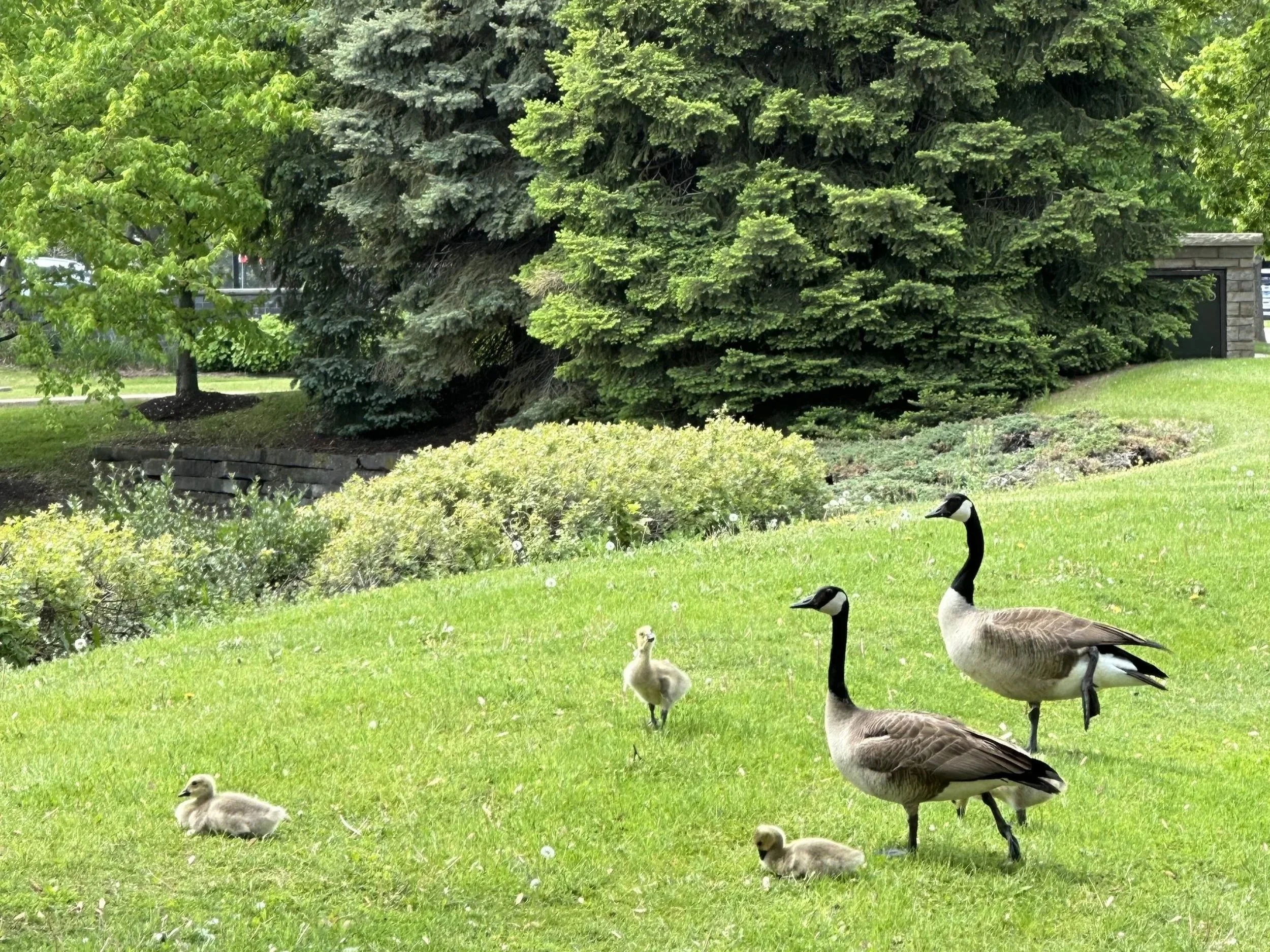
Canada Geese goslings and adult Canada Geese on a lawn.
Photo by Joseph Bruno
Canada Geese are common in the Midwest year-round and usually comfortable around humans, which makes them great subjects for photography and watching. Beyond their iconic image, there is still much more to learn about this fascinating species. Next time you see them around, maybe linger a little, and you might just notice something new!
Sources
Encyclopedia Britannica, Canada Goose: https://www.britannica.com/animal/Canada-goos
The History of the Giant Canada Goose: https://splitreed.com/the-history-of-the-giant-canada-goose/
The Comeback of the Canada Goose: https://birdsanctuary.kbs.msu.edu/2021/08/11/the-comeback-of-the-canada-goose/
Canadian Government Website on Managing conflict with geese: https://www.canada.ca/en/environment-climate-change/services/migratory-bird-conservation/managing-conflicts/frequently-asked-questions.html
Hunting Using Goose Calls: https://www.wildfowlmag.com/editorial/six-tips-for-hunting-canada-geese/392614
Wild Goose Chase in Chicago: https://chicagomaroon.com/39029/grey-city/the-wild-goose-chase-to-chase-out-the-canada-geese/
Study: Canada geese beat humans in longstanding territory battle: https://aces.illinois.edu/news/study-canada-geese-beat-humans-longstanding-territory-battle
All About Birds, Canada Goose: https://www.allaboutbirds.org/guide/Canada_Goose
Draining America: https://blogs.loc.gov/maps/2024/02/draining-america
Special Canada Goose Permit: https://www.fws.gov/service/3-200-67-special-canada-goose
Movement ecology and habitat use of Canada geese using major metropolitan areas in the context of human-wildlife conflicts: https://www.ideals.illinois.edu/items/123212
Canada Goose Gestures: https://www.fortwhyte.org/wp-content/uploads/2020/04/FWA-GooseBehaviour-2020.pdf
Canada Geese Behavior and Biology, Indiana Department of Natural Resources: https://www.in.gov/dnr/fish-and-wildlife/hunting-and-trapping/canada-geese-management/behavior-and-biology/