
Picture a nest of cattails, sedges and weeds, lit by the spring sun, that holds an olive-colored, gray-speckled egg. Every day for 30 days or so, beginning in April and ending in May, the proud parents take turns incubating this egg. Finally it cracks open, revealing a Greater Sandhill Crane chick covered in down feathers. Cinnamon-brown with patches of gray, she will eventually attain mainly gray feathers after a year and the signature red mask around two years old. Although this bird is an only child, very often cranes will lay two eggs. If there are multiple chicks in a brood, generally just one survives. However, two chicks may make it if their caretakers separate the two by having each chick follow a parent, which lessens the competition for food. The breeding season normally lasts from late spring to early fall.
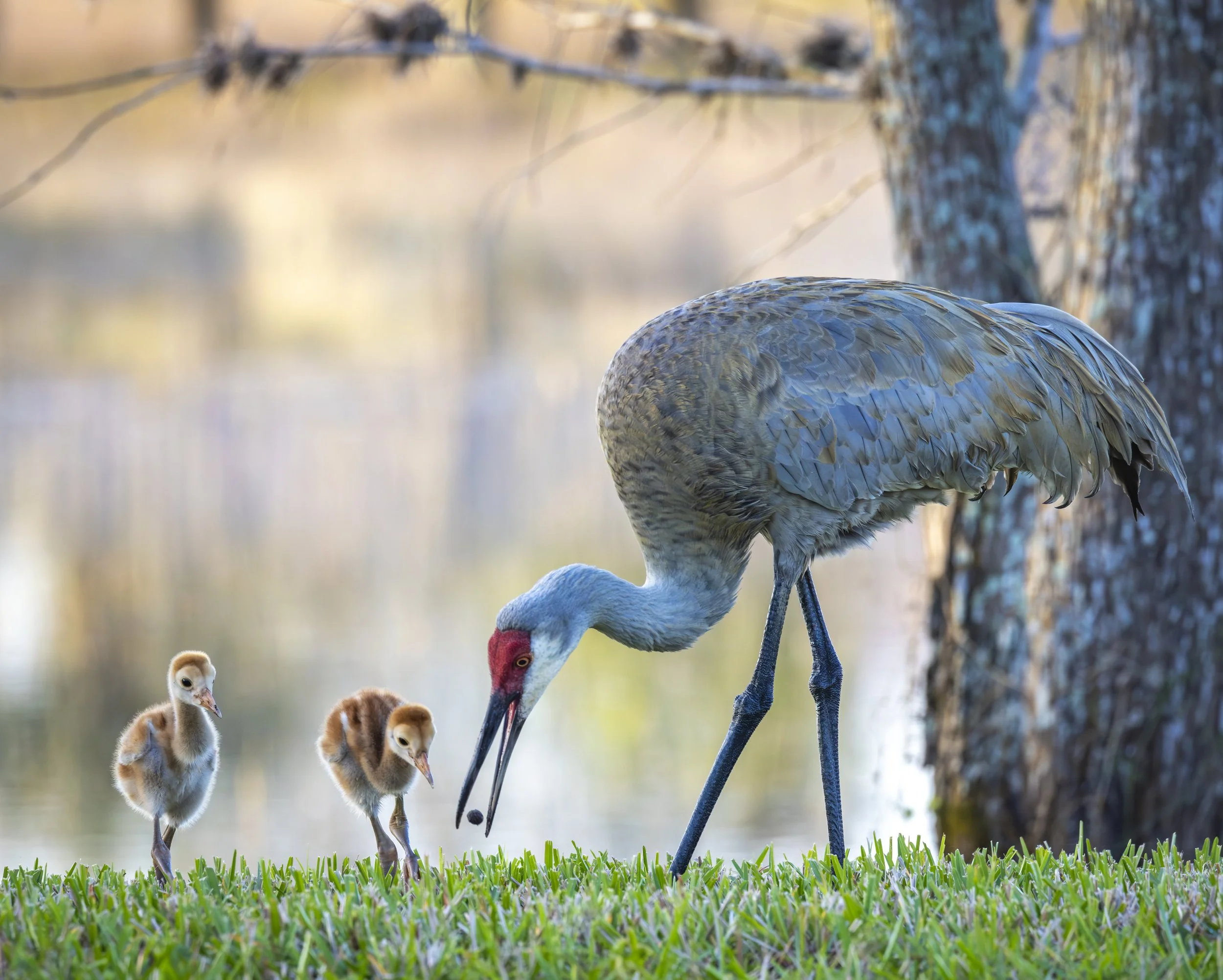
Sandhill Crane, adult and chicks, and Stenotaphrum secundatum (St. Augustine Grass), Sarasota County, Florida
Mary Lundeberg/Audubon Photography Awards
Sandhill Crane chicks, also known as colts, are precocial. Within a day of hatching, the colt is able to leave the nest. Mom and Dad feed her initially, but by month three, she can nourish herself. It takes her around the same time to begin flying; for most Sandhills, the first flight happens 65-75 days after hatching. But even after a juvenile becomes an independent flier, it will stay with its parents until it’s time to migrate southward. When the journey to warmer climes begins, the young crane will be joined by a giant flock of like-minded Sandhills. In her case, she will be traveling from Northern Illinois to Jasper-Pulaski Fish & Wildlife Area in Indiana.
As a whole, fall migration runs from September through December. Typically, for those residing in Northern Illinois, the peak of southerly movement comes in November and ends in mid-December. Sandhills starting out in this state may go to northern Alabama or parts of Indiana. For those starting elsewhere, Arizona, Oklahoma, New Mexico, Texas, California, or Mexico may be attractive destinations. Summer breeding grounds include Wisconsin, Minnesota, Michigan, Idaho, Oregon, or Alaska. During spring migration, the Platte River basin of Nebraska is a popular stop; in fact, the name of the bird comes from the Sandhills near the Platte River as hundreds of thousands of cranes flock here.
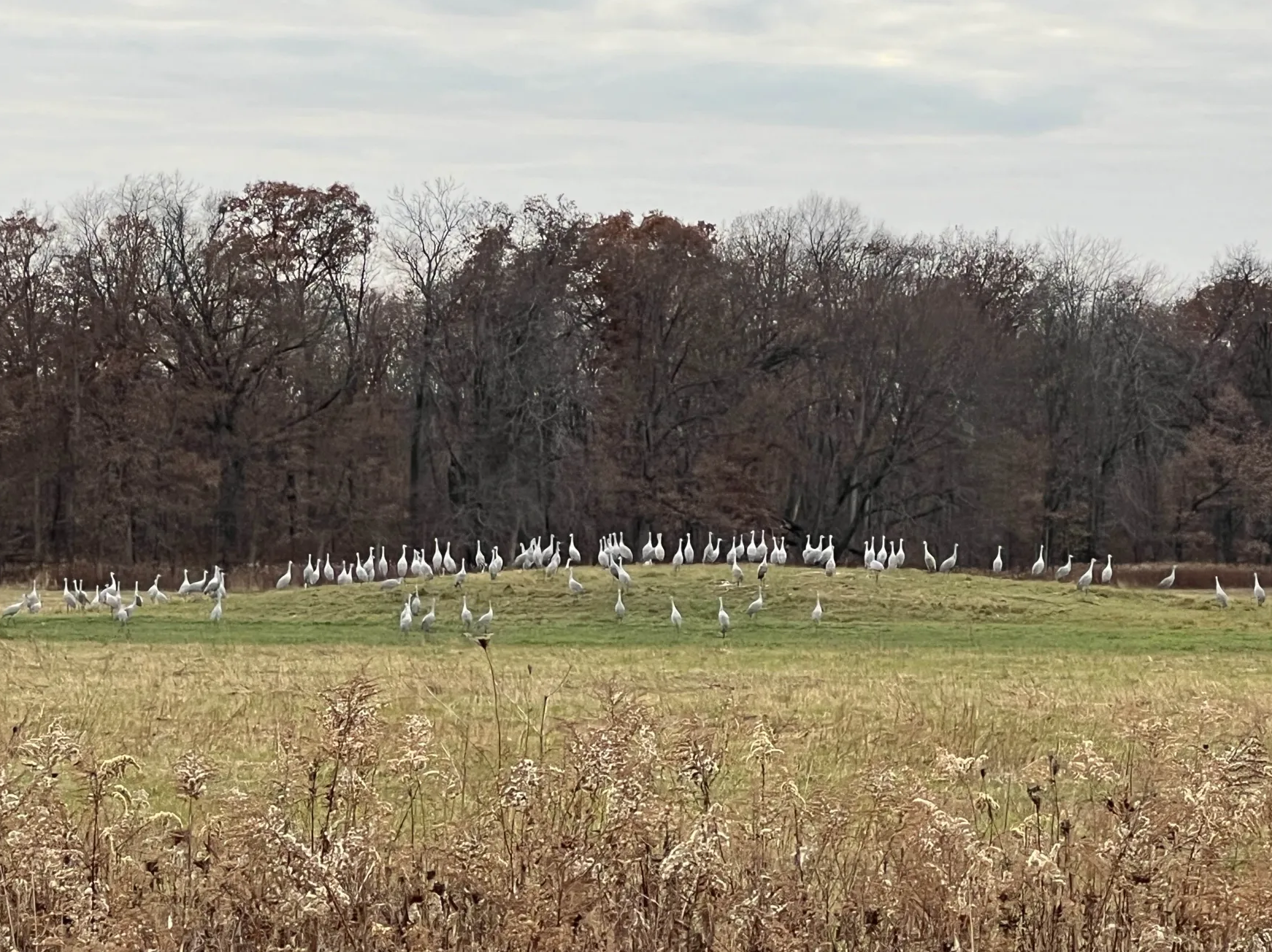
Sandhill Cranes at Jasper-Pulaski Fish & Wildlife Area
But some subspecies don’t migrate: Cuban, Mississippi, and Florida Sandhills are non-migratory. In all, there are six subspecies, although some contend that there are only five. The five with consensus are Lesser, Greater, Cuban, Mississippi and Florida. The sixth is Canadian, although there are arguments that it could be combined with Greater. Lesser, Greater, and Canadian Sandhills can be found breeding in the northern United States, Canada, and Siberia, and wintering in northern Mexico and more southern parts of the U.S. Additionally, Lesser Sandhills tend to breed at higher latitudes.
Note that cranes do not migrate on a set time schedule. They are intrinsically affected by outside temperatures; if it is warm enough, cranes will stay where they are. Climate change has caused an overall trend of earlier spring migrations and later fall migrations, leading to potential negative consequences. For instance, if a crane arrives at its breeding ground too soon, there may be scarce food resources.
Not too far away in Wisconsin, going through similar stages in life in the late spring and summer, is a young Whooping Crane. Out of a brood of two, he is the sole survivor. Whooping Cranes typically lay two eggs, with only one making it through childhood. Upon hatching, his feathers are a blotchy mix of brown and white; his adult plumage will come in during the next summer. It takes him a little longer to master flight compared to his Sandhill counterpart; Whooping Cranes need about 80-90 days to become capable of flying.
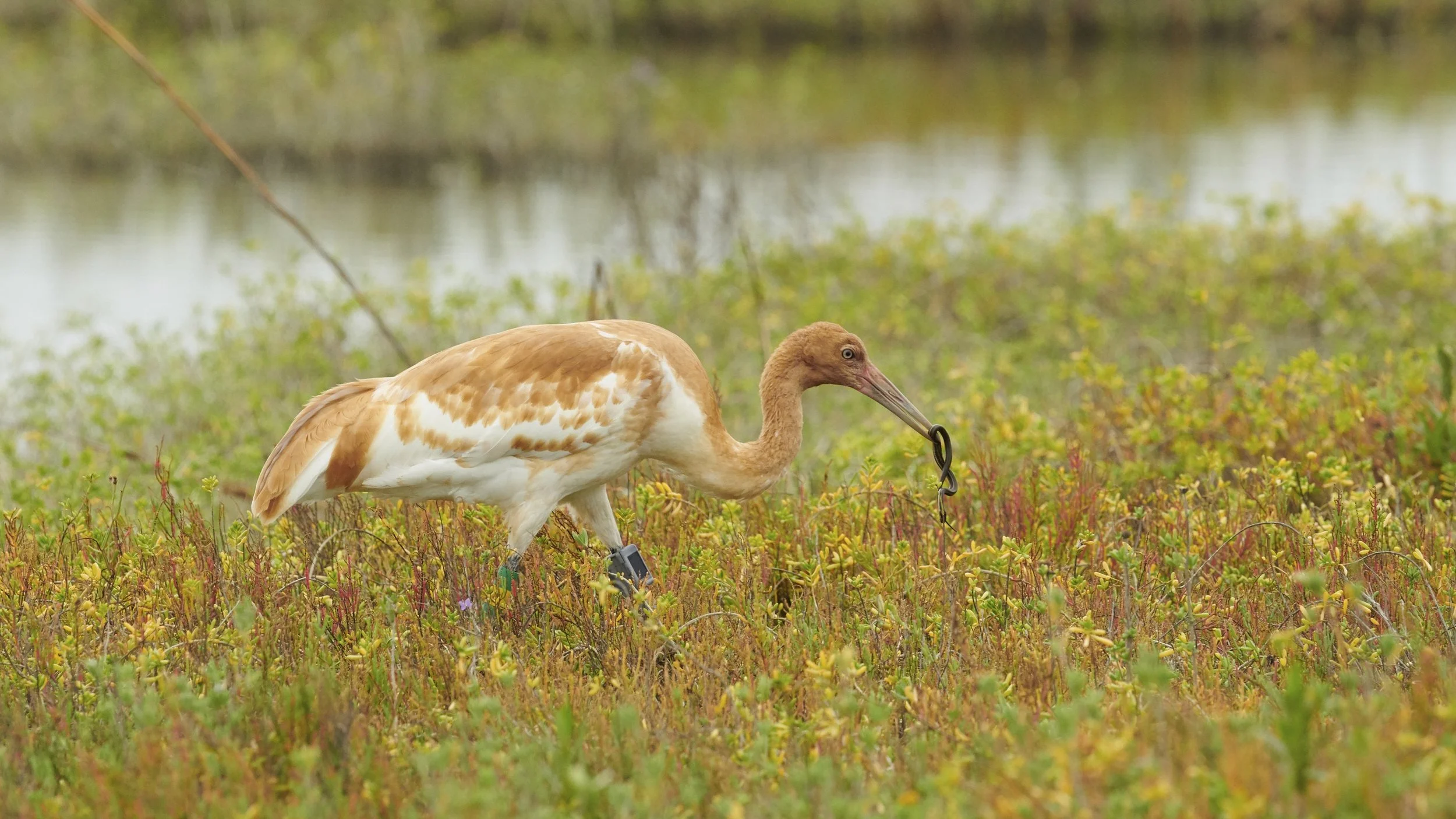
Whooping Crane, juvenile, Aransas National Wildlife Refuge, Texas
Jeff Meaux/Audubon Photography Awards
This particular Whooper is part of the Eastern Migratory Population, a group of Whooping Cranes intentionally reintroduced to the eastern United States back in 2001. Thanks to concentrated efforts by the Whooping Crane Eastern Partnership, there are currently 68 such cranes in the Eastern Migratory Population per a December 2025 update. This population typically lives in Wisconsin during the summer months and in the southeastern United States during the winter. Some might migrate through or even overwinter in Illinois. Other Whooping Cranes may live in Canada during the breeding season and winter on the Gulf Coast, or stay in Louisiana year-round.
Unfortunately, Whooping Cranes are not common anywhere in the United States; they are an endangered species. Conversely, there are over a million Sandhill Cranes. But the number of these cranes has not always been so high. Due to feather collecting, rampant hunting, and habitat loss among other factors, Sandhill Cranes, along with Whoopers, experienced a dramatic decline in population in the 1800s and early 1900s. Thanks in part to laws and regulations, as well as concerted efforts to restore wetlands, prairies, and marshes, the Sandhill population has grown.
However, Sandhills have an extra advantage. They are able to adapt to human-altered locales, including cities. Whooping Cranes, on the other hand, have a stronger dependency on wetlands and do not adapt as easily to landscapes purposefully shaped for human use. This may explain why Sandhills are considered ‘Least Concern,’ but their cousins are struggling. It must be noted, however, that the Mississippi and Cuban subspecies are also endangered.
Two Sandhill Cranes in the Chicagoland area
Joseph Bruno
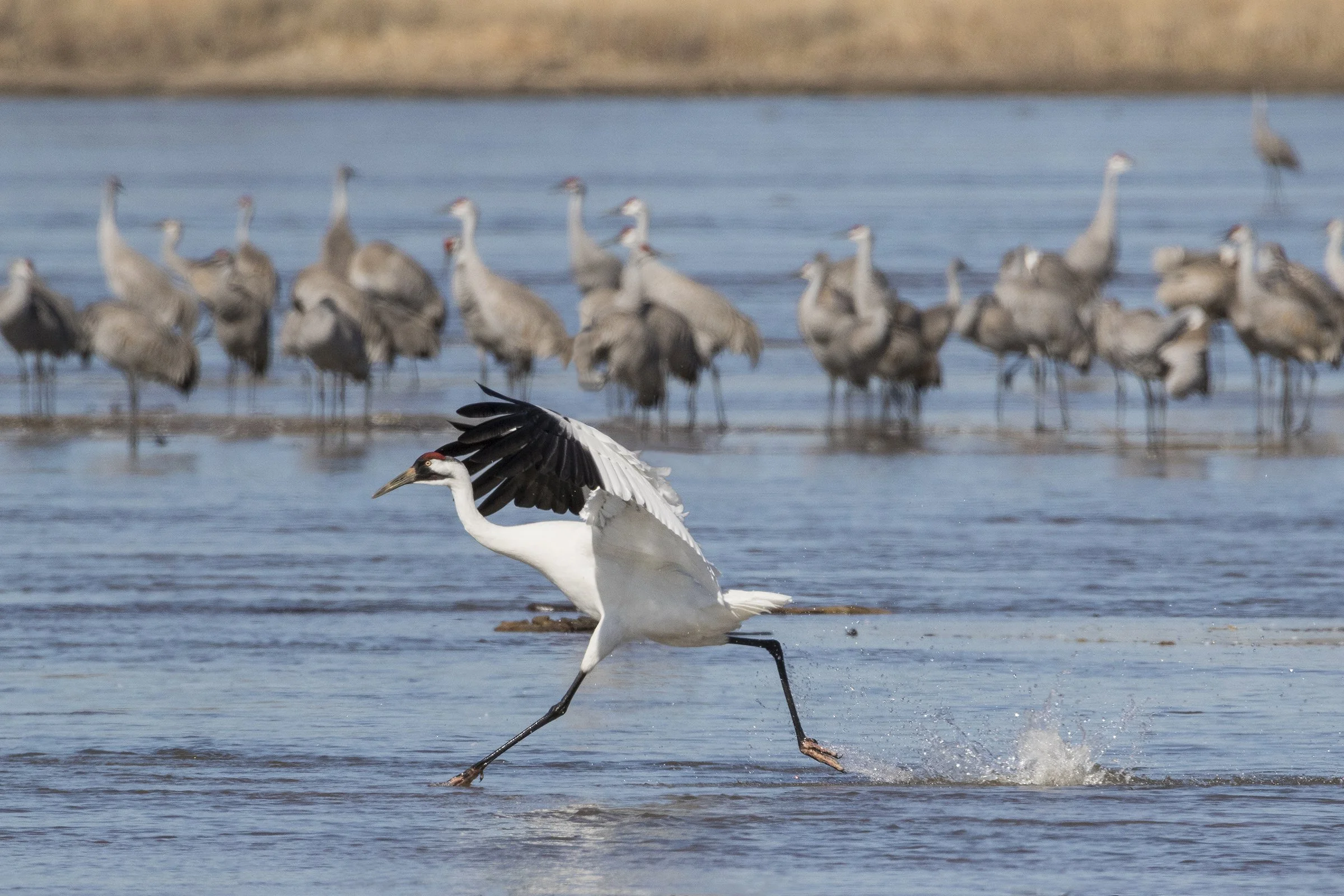
It should be no surprise then that a Whooping Crane creates a stir when it is spotted among a flock of Sandhills. From high above, it may be difficult to differentiate the two as both fly with neck and legs outstretched. But on the ground, it is quite different. When it comes to an adult, a full-grown Sandhill Crane is generally shorter. Height ranges from 3-5 feet, with the smallest being the Lesser, at 3-3.5 feet, and the tallest being the Greater, at 4.5-5 feet. Sandhills have a red, heart-shaped patch of skin on their face that runs from the beak to around the eyes. This distinctive facial feature does not develop until a Sandhill is about two years old. Their eyes are amber and the rest of their face is white. The plumage of their body and wings is gray, and their legs are black. If there is iron-rich mud in their habitat, these cranes will rub it into their feathers, partially turning their plumage a rusty brown during spring and summer.
The Whooping Crane can claim to be the tallest bird in North America at five feet. These waterbirds are predominantly covered in white feathers; they also have black wingtips and a red patch of skin from the bill to the top of the head. Furthermore, Whoopers have black feathers on their cheeks, much like a mustache, black legs, and yellow eyes.
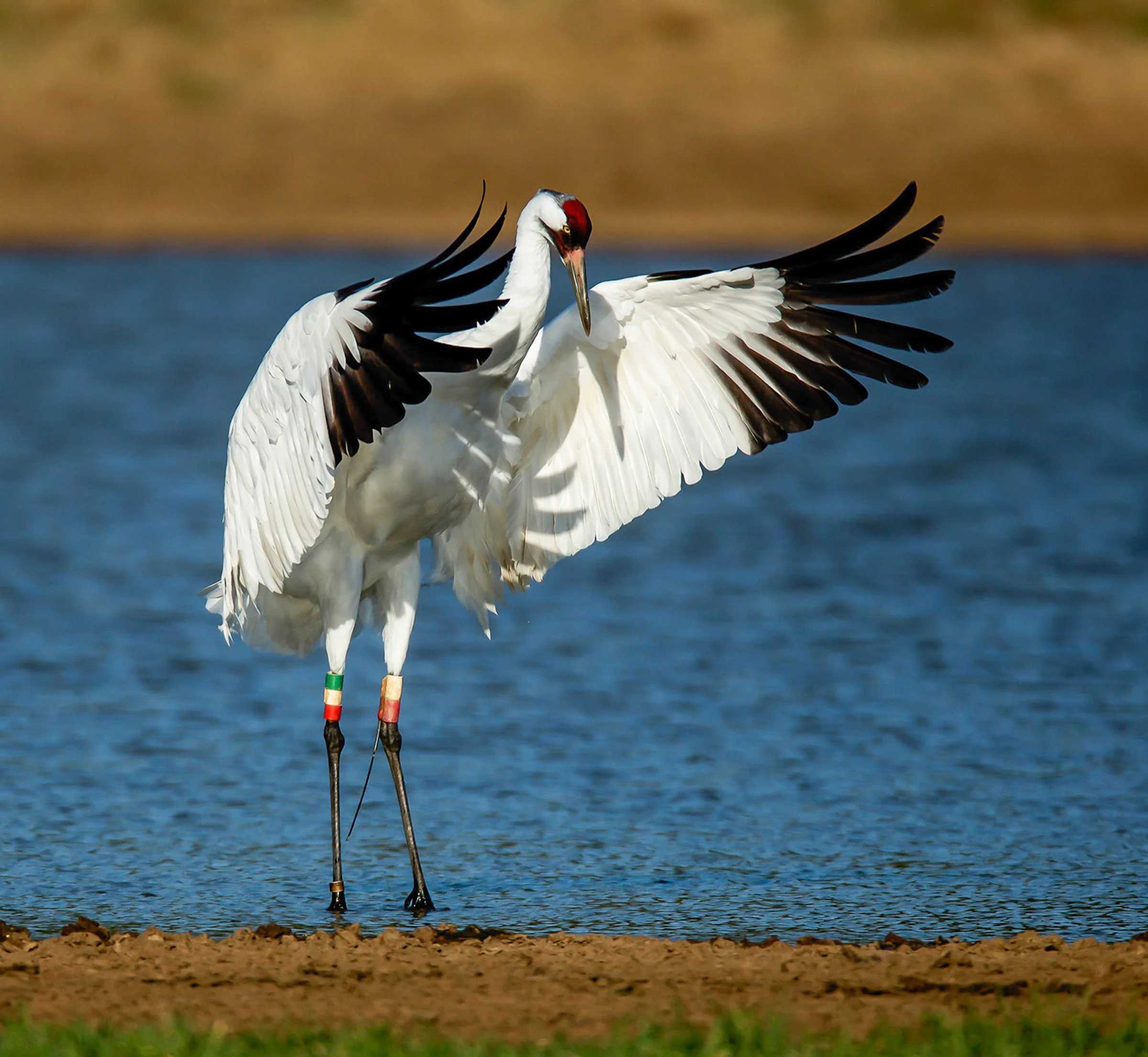
Whooping Crane
Karen Willes/Audubon Photography Awards
Besides visual appearances, another difference between the two is auditory. Sandhill Cranes are known for their ‘karoo’ call, created via a long windpipe that coils in the sternum. Interestingly, the crane is able to elongate or shorten their trachea depending on the signal they need to give, whether a rattling call warning of a predator or a more purr-like click to signal it’s about to fly. The Whooping Crane is distinguished by its ‘whoop’. When they are giving a guard call or duetting with a mate, they sound like they are whooping. Their powerful calls are also driven by an extensive trachea that’s coiled in the chest. Socially, Sandhill Cranes like to roost and forage in large flocks. During migration they could be in groups numbering in the thousands. Whooping Cranes, who sometimes migrate with Sandhill Cranes, form smaller family or pair groupings. Both species are omnivorous and can sustain themselves on seeds, berries, grains, invertebrates, and small vertebrates.
Cranes are monogamous and commonly stay with the same mate for life, unless a tragic death happens or they are unable to produce young. Sandhills generally start breeding between the ages of two and seven years. To attract a mate, they will partake in a dance, during which they will perform such actions as bowing and leaping. The male may also take a clump of grass and toss it into the air with an outstretched neck. Pairs also participate in unison calling in which they coordinate complex calls. Although males and females are normally very difficult to distinguish, during unison calling the male has his beak straight up while the female’s bill is more horizontal. The former will give a call and the latter will answer with two notes.
Whooping Cranes also take time to start breeding; they normally begin when they are 3-5 years old. They dance while courting as well and enjoy unison calls with their mate. However, for both crane species, dancing is not confined to courtship; it can also be viewed at other months and is used to strengthen the bond between two birds, encourage motor development, and relieve tension.
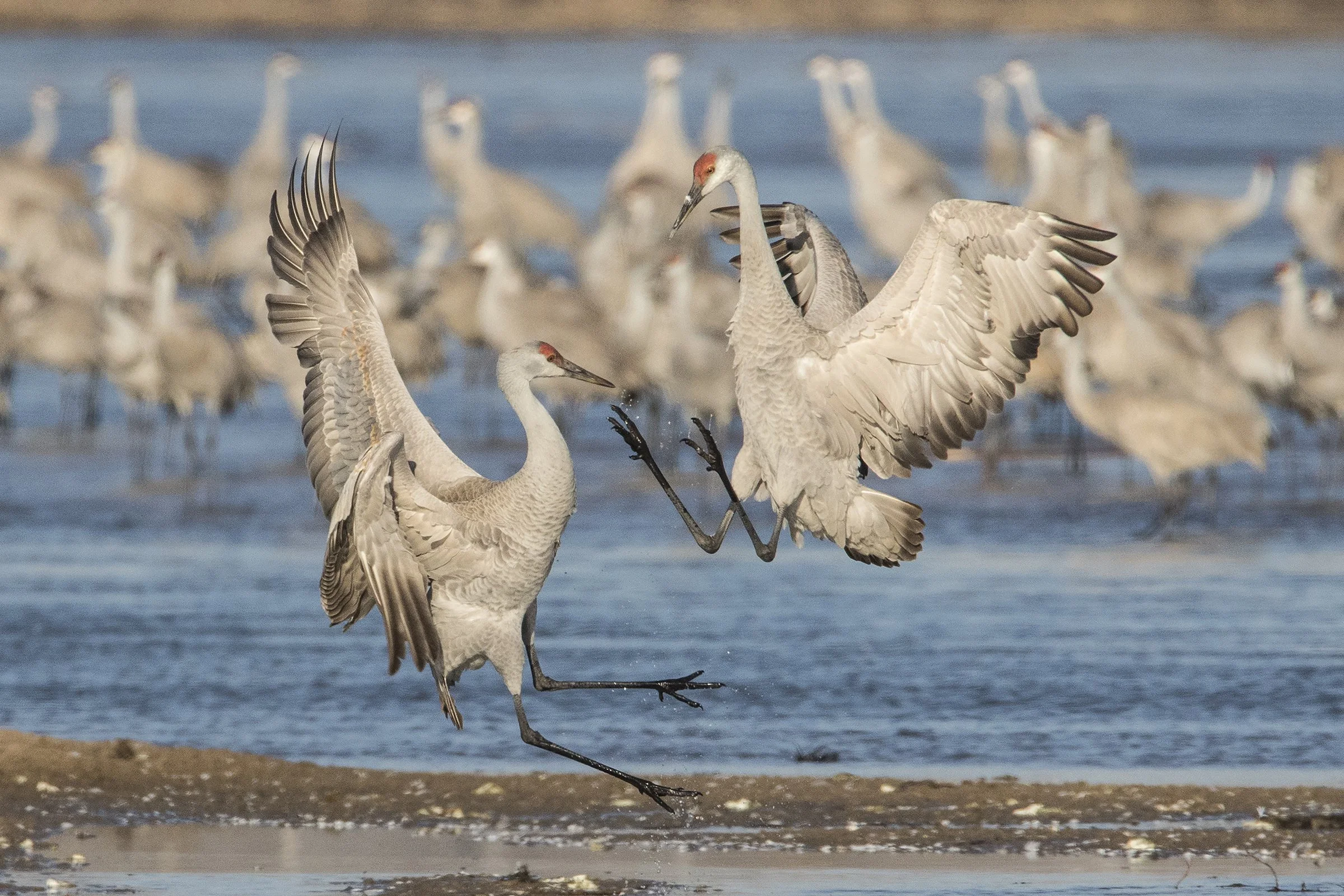
Sandhill Crane, male and female, Platte River, male and female, Nebraska
Beverly Houwing/Audubon Photography Awards
The ancestors of cranes graced the earth over nine million years ago, and we need to ensure these waterbirds are here for millions more. Give cranes space, join the Annual Midwest Crane Count held mid-April every year, and support organizations that help these amazing birds, such as the International Crane Foundation!
Sources:
Sandhill Cranes:
Illinois’ Cranes: A storied past and a hopeful future
DNR: Fish & Wildlife: Sandhill Cranes
Sandhill Crane | Colorado Parks and Wildlife
Sandhill Crane (U.S. National Park Service)
Fall Crane Viewing | Iain Nicolson Audubon Center at Rowe Sanctuary
Sandhill Crane | National Wildlife Federation
Sandhill Crane Ecology and Damage Management
Crane Nesting Facts + FAQs – Colorado Crane Conservation Coalition
Fall Migration: Viewing Sandhill Cranes in Michigan
Sandhill Crane Hunt in Wisconsin? Part II: History and Biology
Sandhill Crane | Audubon Field Guide
Sandhill Crane Life History, All About Birds, Cornell Lab of Ornithology
Whooping Cranes:
Whooping Crane Eastern Population Update - December 2025
Whooping Cranes in the Eastern Population – The Journey North
Into The Wild - International Crane Foundation
Climate Change Has Whooping Cranes Starting Their Spring Migration Earlier | Audubon
Whooping Crane Life History, All About Birds, Cornell Lab of Ornithology
Bird of the Week: Whooping Cranes – Travis Audubon
https://nationalzoo.si.edu/animals/news/featured-creature-whooping-crane