
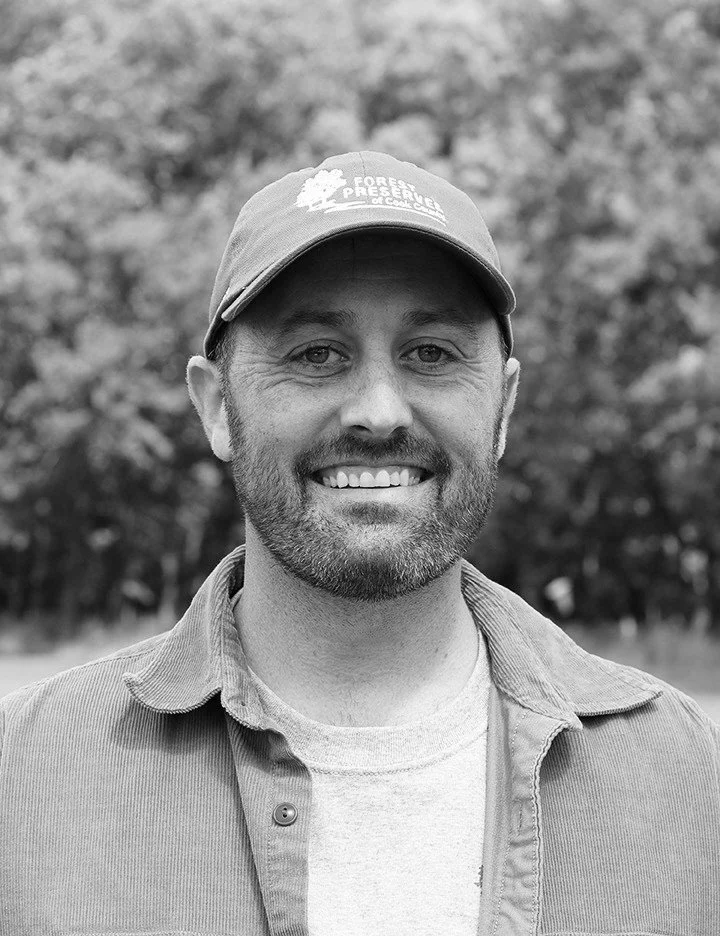
The Forest Preserves of Cook County (FPCC) are 70,000+ acres of diverse habitats and recreational areas, and Adam Bianchi is the one in charge of overseeing it all. As the General Superintendent of the Forest Preserve District of Cook County, he manages a balance between preserving the land and ensuring people can enjoy the natural resources inherent to the area. The Chicago Bird Alliance had the privilege of interviewing Adam and learning more about his background, his conservation philosophy, and his priorities for FPCC, among other items of note.
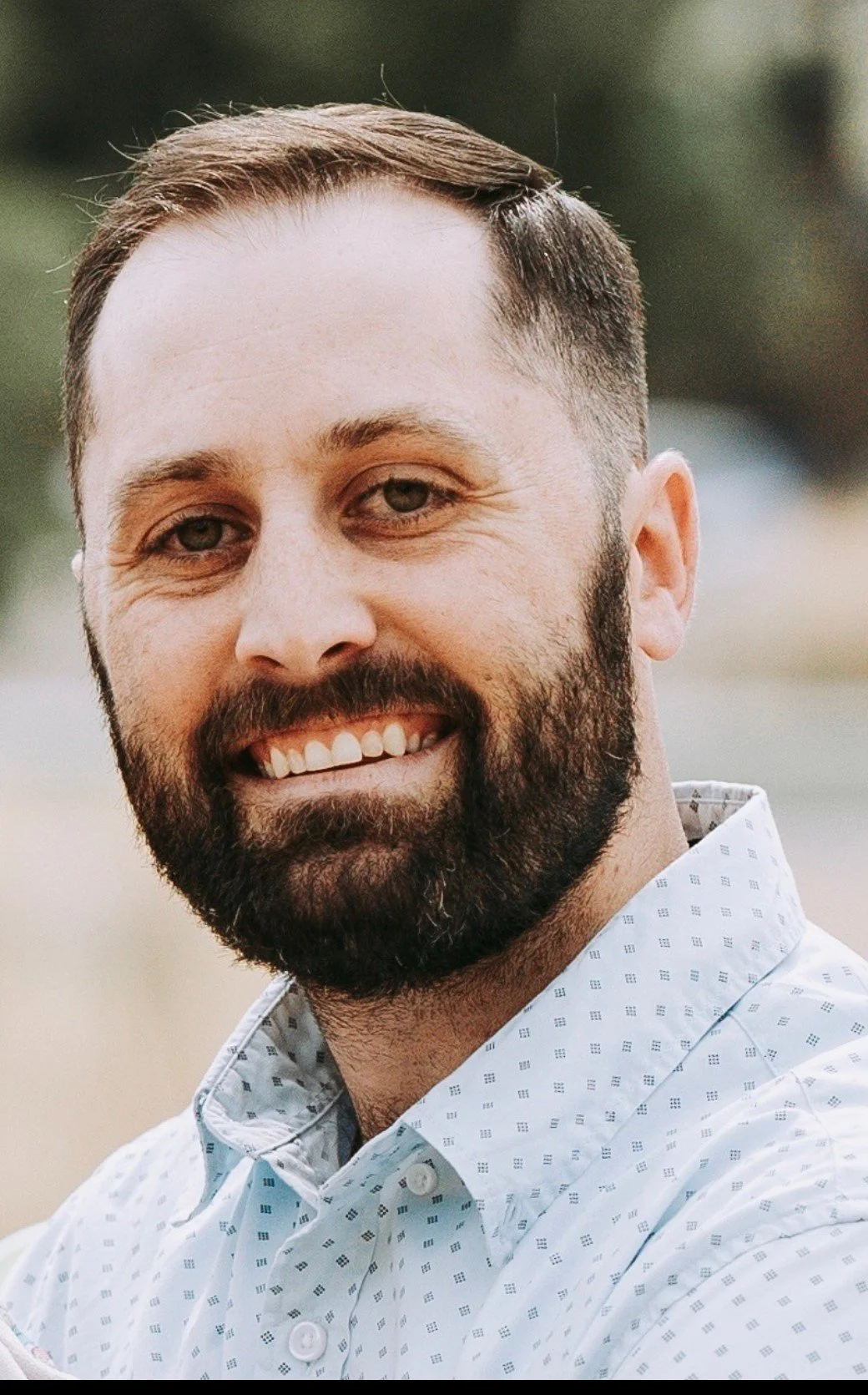
Photo of Adam Bianchi, provided by Adam
Before being appointed general superintendent, Adam majored in forestry at Iowa State University and worked in the United States Forest Service. He has an extensive background in managing public lands, ensuring people can enjoy the outdoors while accomplishing conservation goals. Growing up in a rural part of Iowa, fishing and playing in the woods, Adam has long felt a connection to nature. He observed wildlife thriving in small, unexpected areas “along fence rows, or ditches, or deep in ravines that were hard to turn into corn and soybeans. So I always just knew from the beginning that there was something special when it came to nature in some of these spaces.” This led to an interest in conservation and natural resource management. Per Adam, “I really could see that habitats matter, and I felt forestry gave me that background understanding.”
When he attended Iowa State, he gained “a strong grounding in ecological systems.” Additionally, the “US Forest Service really shaped my career path… I learned through the US Forest Service thoughtful stewardship and trying to figure out how to balance recreation, conservation, and long-term resilience. Although I learned the science and understood the ecology behind things, when you are actually doing it and putting it into practice, you realize that it’s not just about using the best available science; there are social and political issues that come into play.” Furthermore, there are management factors that can drive decision-making. So, “the forest service really prepared me well for a position here where you have to find a balance between protecting and restoring the land, but also realizing that people are going to have a continued influence on it – it’s public land and they should be connected to it.”
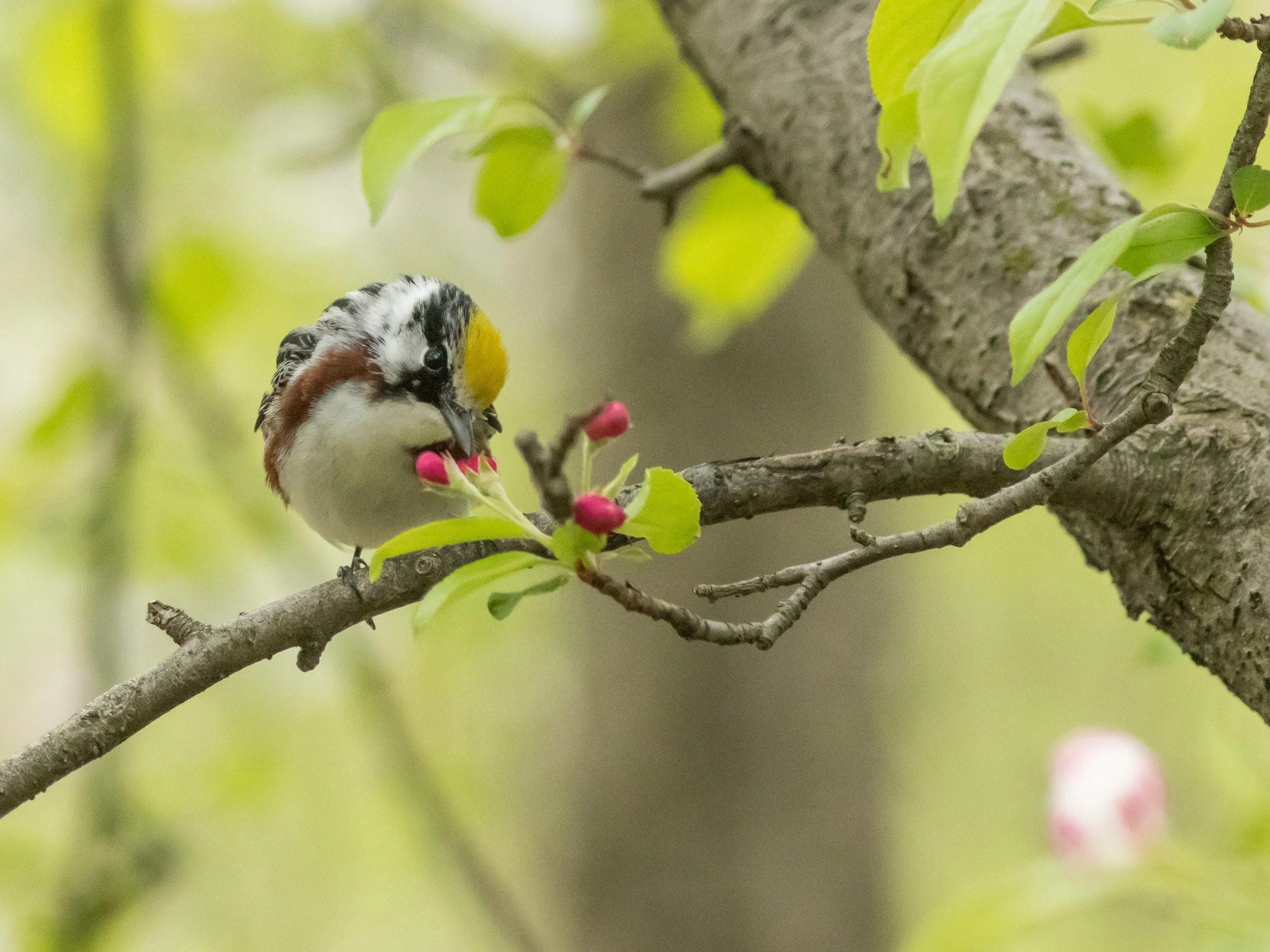
Chestnut-sided Warbler on Malus sp. (Crabapple), Forest Preserves of Cook County, Cook County, Illinois.
Sharon Dobben/Audubon Photography Awards
This idea that people should be connected to the land is indicative of Adam’s conservation philosophy. There are various schools of thought when it comes to conservation. One end is occupied by the likes of Henry David Thoreau and John Muir, who believed that large swaths of land needed to be preserved from human activity. Gifford Pinchot, the first chief of the United States Forest Service, felt differently and believed that people deserved to utilize natural resources without the need to spare anything. For Adam, his view of conservation falls in the middle like Aldo Leopold’s. From his perspective, “you cannot remove people from the system… Because we have an influence on that system, we have to be considered in it… We are impacting it whether we think we are or not.”
Growing up in an agricultural hub, he could see how the land would be used for human needs, which has centered his viewpoint around “this idea of stewardship and co-existence.” As Adam notes, the preserves should be cared for “in a way that allows both wildlife and people to thrive at the same time. I believe that people should interact with these ecosystems respectfully and intentionally. They should be able to enjoy them, learn from them, and understand that their actions have real impacts.” His role should be to foster a connection to nature while “simultaneously trying to safeguard its ecological integrity for future generations.” It is a balancing act between leaving parts untouched and creating “opportunities where people can have a larger influence and impact.”
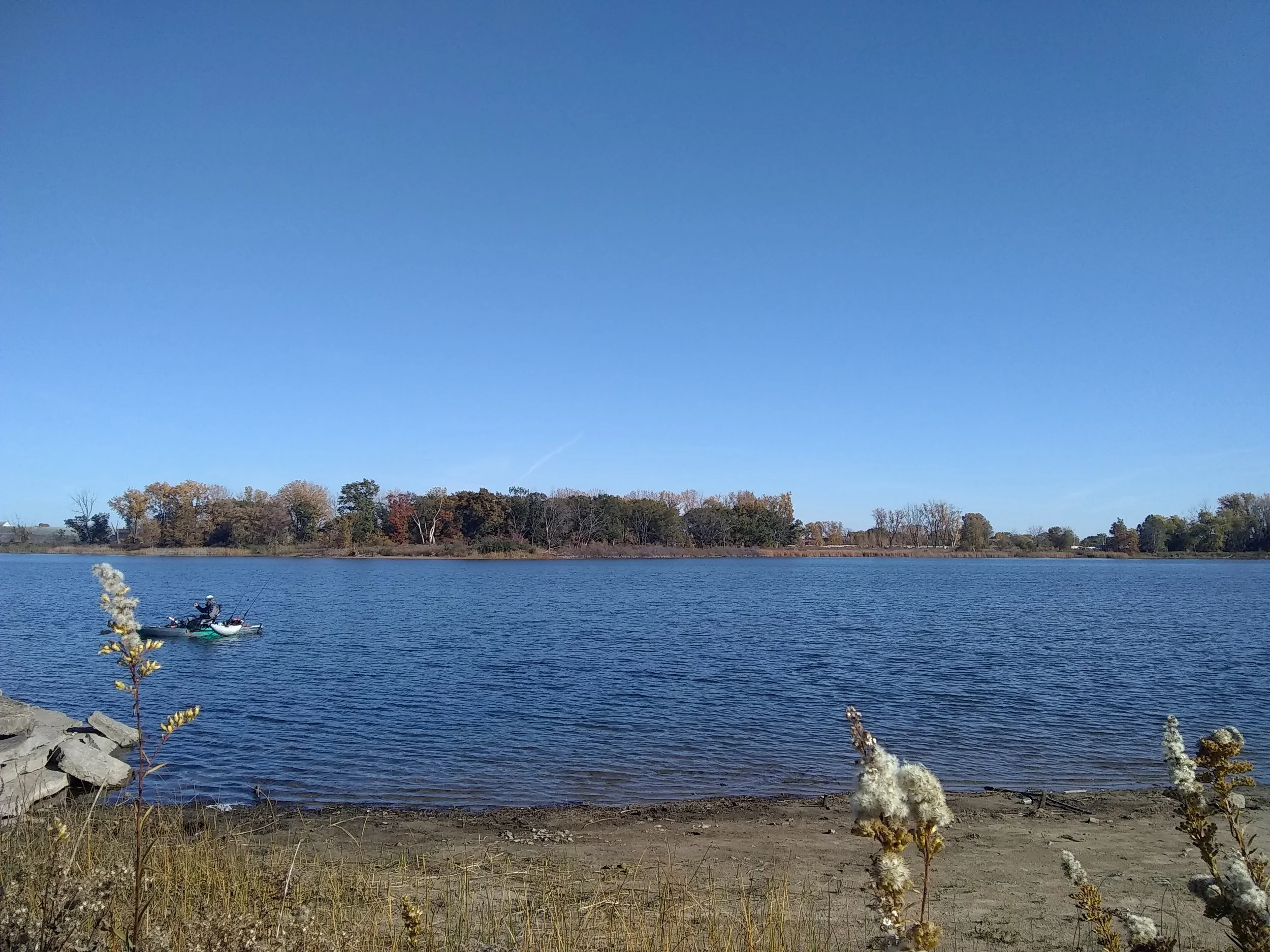
Powderhorn Lake in Burnham, Illinois
By Legimet - Own work, CC BY-SA 4.0,
Along those lines, the FPCC offers many recreational activities - one can go camping, hiking, and boating, among others - and there is a packed calendar of events for the public. Between ensuring there are spaces for public activity and preserving other areas lies a crucial need to prioritize. What is imperative is ‘mission alignment,’ and critically thinking about long-term impact. Key priorities include maintaining ecological health, habitat restoration, finding ways to manage invasive species, and protecting biodiversity. From there, “we can start to look at equitable access, safety, meaningful and impactful recreation and educational opportunities and programming.” Long-term strategic planning helps guide this work. Furthermore, input and expertise from local communities, staff, volunteers, and partners help shape decision-making.
What’s special about Chicagoland is that north/south/east and west all have different ideas on what the forest preserves should be. That scenario is not always the case, and the diverse opinions are appreciated. However, despite all the input, sometimes “we think we got it figured out, how to manage that piece of land, and we’re wrong. Either the community tells us, or the wildlife tells us, or we learn and adapt… I think that’s the most important thing - realizing that you got to be able to be flexible and adapt to it.” A salient point Adam makes is that everything is a management decision, whether you do something or not, and sometimes you need to move forward with the data and expertise at hand.
With so much potential on what can be done it makes sense to establish strong partnerships. Valued partners include those that “bring a level of expertise, shared values, very much a collaborative mindset.” They help “us think about the science as well as the communities.” Likewise, they understand the hand each organization is dealt with differs, but everyone is “playing the same game” and trying to reach similar goals. It is vital for partners to recognize that the FPCC is a multiple-use organization that is “trying to balance all kinds of things” and the fundamental challenges that come with that.
The Chicago Bird Alliance works with the forest preserves by helping FPCC “understand species’ needs” as well as “think about our management and how we can have better impact for birds particularly. CBA has been fantastic in helping us engage with the public in meaningful ways and strengthen how we are getting input and thinking about things.” Adam observes that “we can’t do this work alone” and “strong partners really make the preserves go.” The support from “an organization like CBA… cannot be overstated.” Notable institutions such as the Field Museum, Shedd Aquarium, Morton Arboretum, Brookfield Zoo, Lincoln Park Zoo, and Chicago Botanic Garden, as well as research universities such as University of Illinois and Ohio State University, have lent their expertise to the FPCC as well. In general, the number of volunteers and engagement from the community is remarkable, and not something to be taken for granted. At the same time, Adam is aware that there needs to be a symbiotic relationship. “We want to be a good partner back.” Depending on competing priorities or capacity constraints, the FPCC may not be able to engage immediately, but it’s important to Adam that partners are “getting their needs met as well.”
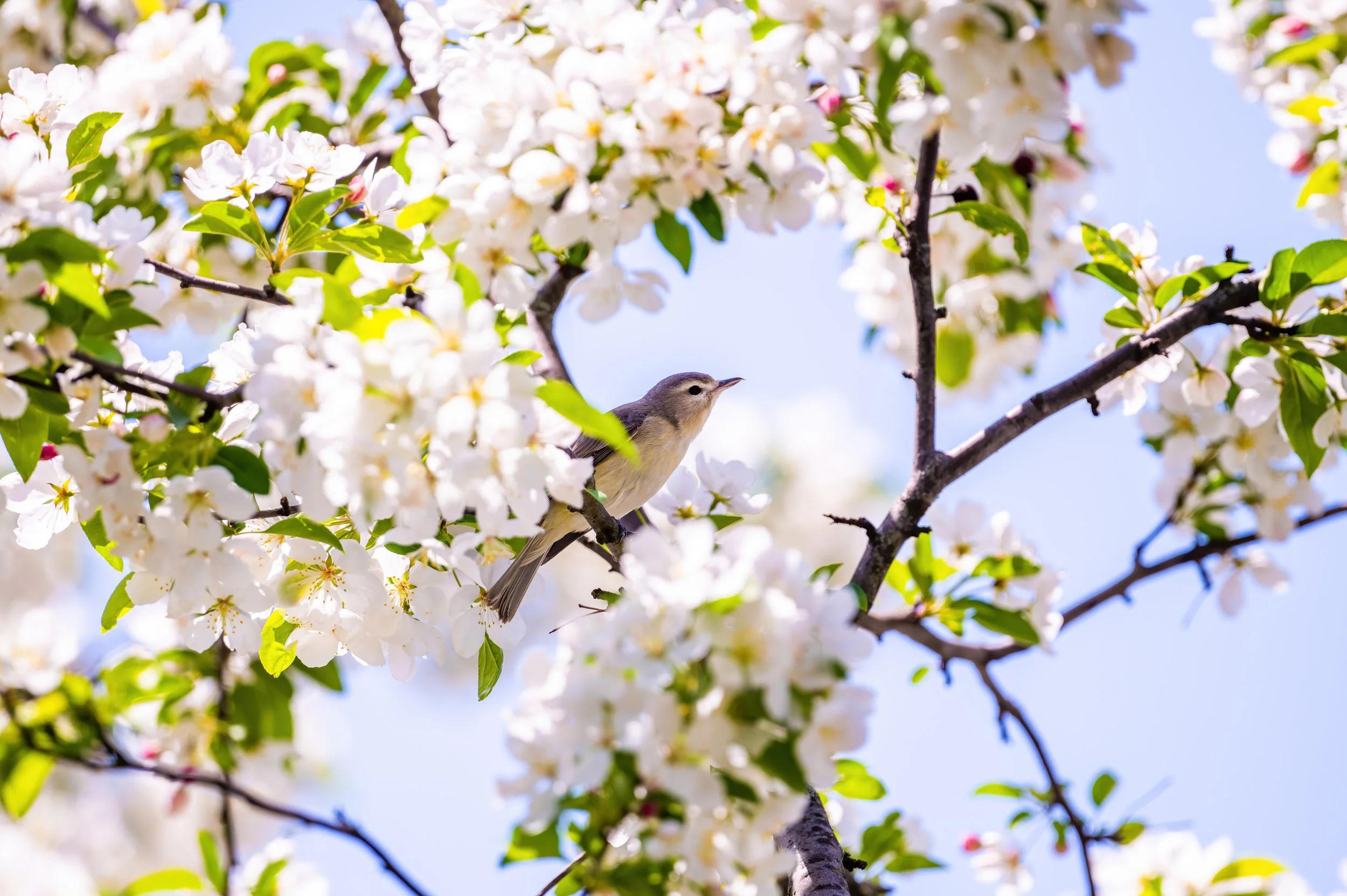
Eastern Warbling Vireo, Chicago Botanic Garden, Cook County, Illinois
Leah Turner/Audubon Photography Awards
As a member of a birding organization, it was especially interesting to hear about considerations made for wildlife, in particular for avian species. “The wildlife department has always been a strong piece within the forest preserves.” Dedicated employees have “continued to shepherd ways to really maintain the biodiversity on the landscape.” Because of that, “wildlife considerations are incredibly embedded, it’s in nearly every decision we make.” When it comes to the birds, the FPCC focuses on habitat quality and “really trying to think about ways that we can protect the remnants that are there and restore the areas - woodlands, wetlands, grasslands, riparian corridors – that really support migration, breeding, and over-wintering. That is a huge focus for us in the way we manage.” Harkening back to the discussion on prioritization, Adam reiterates that “we have a list of priority landscapes that we’re trying to restore and manage” and birds “have a huge influence on that.”
With all the in-depth data at hand from wildlife experts there are still opportunities to explore. For instance, “we rely heavily on the monitoring and the research that we’ve done, and partner organizations like CBA and others, to help us really think about nesting season and should we be burning right now.” Another topic that affects birds involves the noticeable maturity of the tree stands: due to challenges with deer population, the stands are missing the “mid-story and understory pieces in our systems. We don’t have a lot of age-class diversity in there.” Native brush recruitment and plantings is another area Adam is “interested in further exploring with staff to understand how we can alter or put emphasis in our management a little bit differently that particularly would help birds.”
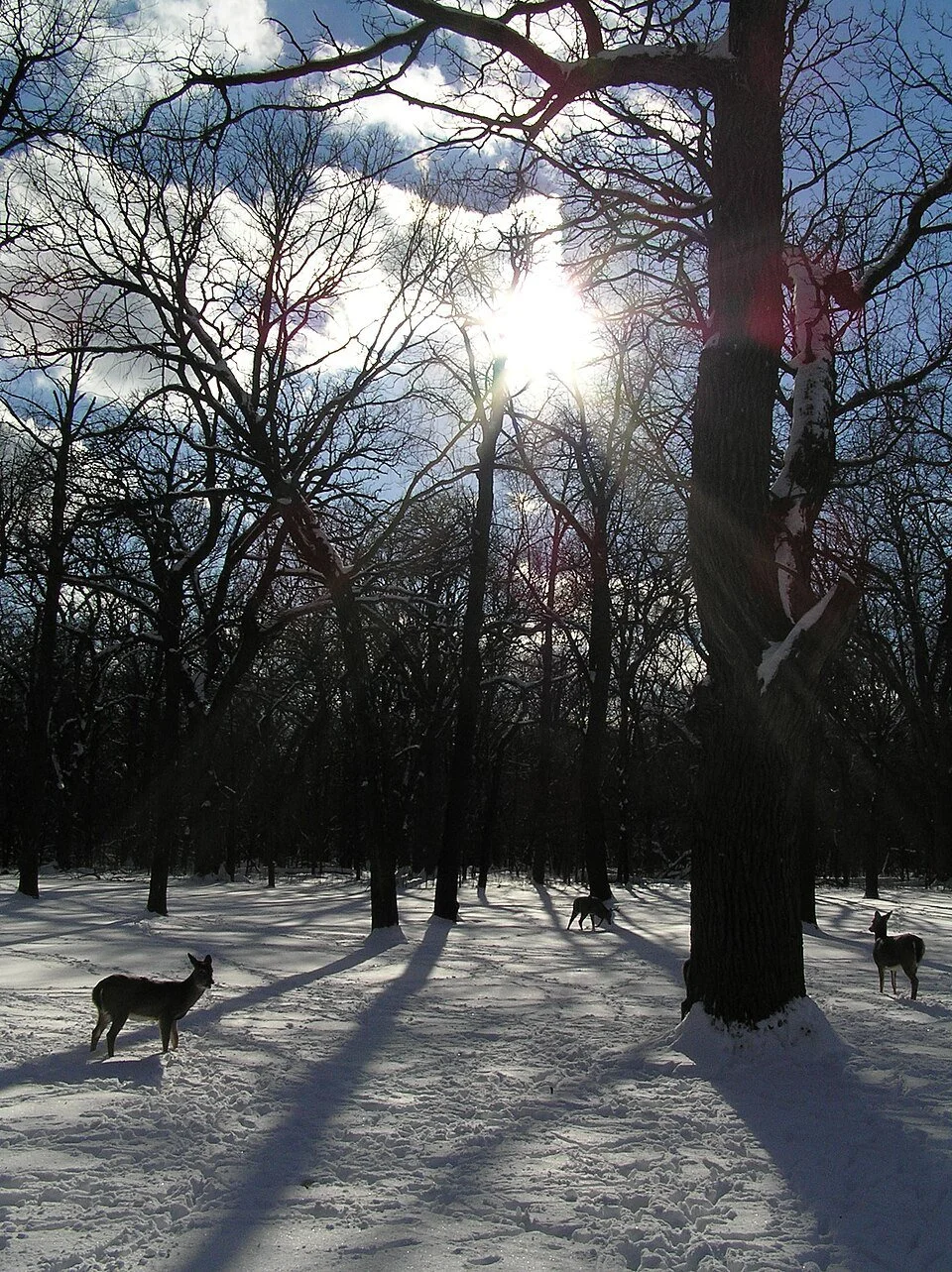
A herd of white-tailed deer (Odocoileus virginianus) in a Chicago forest preserve.
The reach of FPCC is regional, national and even global. What may not be widely known is that FPCC houses zoonotic data from the past 40-50 years. “We’ve been collecting tissue and blood samples - we’ve been collaring and banding wildlife for decades.“ This data is “pretty unique. We get calls from all over the world asking for our data that we have, particularly along the impact on zoonotic diseases. It’s one of the longer, most comprehensive data collections we have. We’ve got freezers and freezers and freezers full of samples – blood and tissue – that we’ve been having for decades. So you can go back and pull blood from a racoon from 40 years ago and see the impact. We’ve played a really large role in wildlife ecology particularly, not only here in the upper Midwest, but on the national and global scale too.”
Having the FPCC be seen “as a national leader in the conservation and public land space” and increasing its regional, national and global reach are key 5-year goals. In addition to great “potential for continued ecological recovery and deeper community engagement”, there has been “significant progress in habitat restoration”, with increased biodiversity and additional educational, recreational, and volunteer opportunities. One target, established in 2014, is to actively restore nearly 30,000 acres over a 20-year timeline; right now there are around 18,500 acres under current restoration. Adam sees “tremendous potential to continue that pace and scale of that work.” And regarding his role “as the general superintendent, it’s really to continue to elevate us…with the community support and partners.”
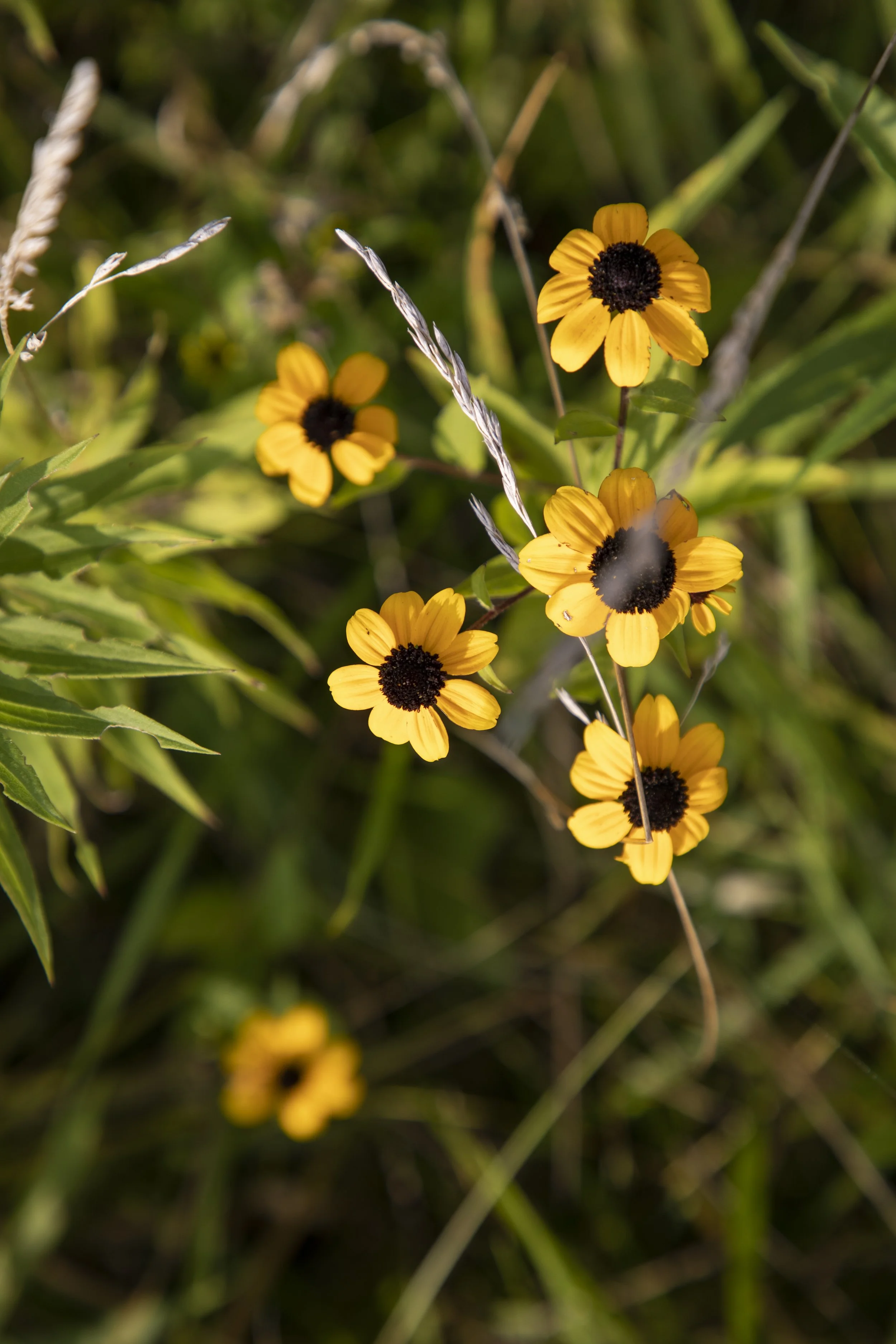
Rudbeckia triloba (Brown-eyed Susan) at Bartel Grassland in Tinley Park, Illinois, August 17, 2021. The Bartel Grasslands, owned by the Forest Preserve District of Cook County, is designated as an Important Bird Area (IBA) because of its importance as a habitat for grassland birds, including breeding Bobolinks.
Luke Franke/Audubon
Naturally, such a high responsibility comes with some concerns as well. As the preserves are intertwined with the urban landscape of Chicago, there are the constant threats of city impact, including habitat degradation and invasive species. Additionally, increasing costs have led to a tight focus on priorities and boxing out scope creep in order to be in a “healthy space when it comes to our fiscal resources so that in the future we can sustain the work that we are trying to do.” A referendum passed in 2022 made a much appreciated positive impact to the budget by adding more funding to the forest preserves, but FPCC has the potential to offer more around its amenities and programming, trail systems, and land restoration/protection.
When asked to impart advice to someone interested in starting a career involving public land management and conservation, Adam shared thoughtful guidance stemming from his vast experience. He believes that while going to school is important, it’s invaluable to go out and gain practical proficiency. Those interested in such a career path need to understand that “it’s not just science alone driving decisions - it’s budgets, it’s social concerns, it’s political concerns, it’s all of those things. Those things you don’t learn necessarily in school when it comes to conservation land management. You learn that by doing, you learn that through finding ways to get creative and innovative, you learn on the ground, those people skills, and how to partner, how to collaborate, and how to communicate. Those are the things that actually matter and move the needle in conservation, not just the science. It’s those interpersonal skills and how you can partner and collaborate… with people with different viewpoints.”
Any hands-on experience would help provide perspective - “there’s no one linear path.” One can volunteer, complete an internship, join a conservation corps program, or work a seasonal job to gain a deep foundation and ascertain if the work resonates with them. Moreover, there are a variety of organizations that offer diverse opportunities and priorities, including non-profits, government (federal, county, regional, etc.), and academia. Regardless of the role, “do whatever you’re doing with passion and intent” and “if it’s not for you, no hard feelings, go do something else.” However, “if this is something for you, go all in. Be passionate about it.” Additionally, “don’t close doors because you think you might not be interested. Say yes, allow those doors to be open. Don’t be afraid to take a job on the other side of the country. There are systems set up in a lot of these organizations and non-profits… to support people who are interested in that.” Make sure not to pigeonhole yourself. And a bit of good news: “there’s a lot of opportunity in the natural resources and conservation fields …you can make it in whatever you’re really interested in.”
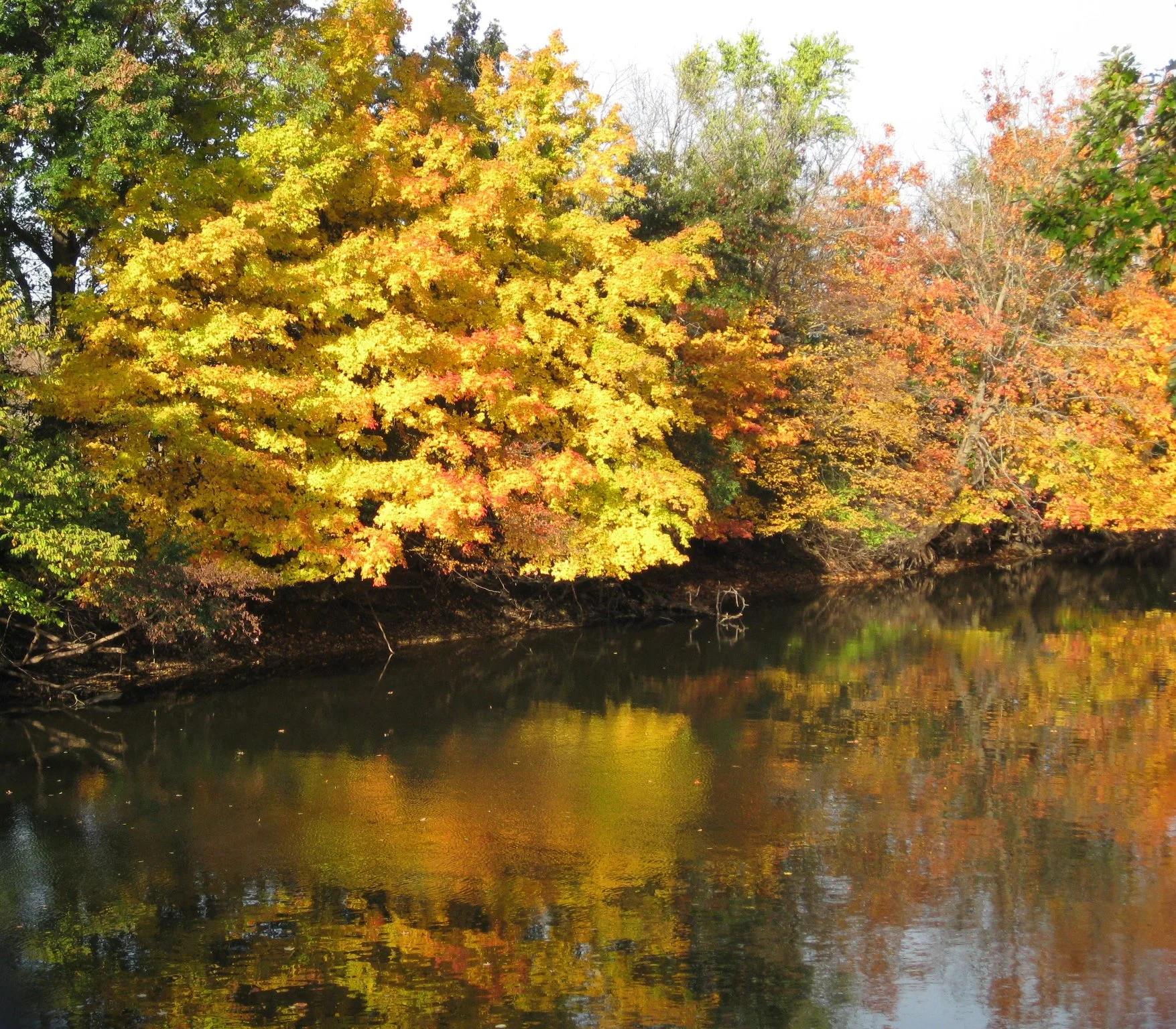
By Brian Plunkett - Des Plaines River, CC BY 2.0,
As superintendent, no two days are alike. “There are days where I’m on the 20th floor downtown and then there are days where I’m out in the middle of a prairie and it feels like I am in the middle of nowhere.” It’s all “incredibly unique and special.” Generally speaking, the weeks consist of meetings with staff and community leaders, as well as policy deep dives and research for management decisions. The key is to help “make decisions that really support the staff to do the really important work. So if I can find ways to move roadblocks for them…hopefully that makes their jobs easier and therefore they can be more impactful.” Adam also likes to “spend as much time as I can out in nature in the preserves - that to me is what it’s all about, that’s what grounds me, seeing the restoration work, talking with visitors, observing wildlife, walking on the trails… this reminds me why the work that I do matters.” In addition, he has the opportunity to be on different boards and loves “being part of the executive side of things for Chicago Wilderness.” At the end of the day, it’s about working with strong partners and “finding ways to collaborate and get great work done.”
The land we have here in Cook County is quite special, with a few points to highlight. First, the FPCC is one of the most biodiverse areas in the region; Adam himself is “really amazed at the biodiversity within the forest preserves.” For birds in particular, the lake effect brings a plethora of migrating birds flying along the Lake Michigan shoreline. Moreover, these preserves serve as an illustration that conservation work makes a significant impact. As Adam observes, “You’ve got landscapes that have been through it all,” living amid, for instance, quarrying, mining, major industrialization, and forced changes in river direction. But despite being “heavily degraded for decades”, the forest preserves are now “supporting diverse plant and animal communities” thanks to considerable efforts in cleaning up Chicagoland rivers and restoring biomes such as prairies, woodlands, and savannas.
This is “a powerful reminder that restoration works. It’s a long-term commitment but there’re huge payoffs with it.” It’s very encouraging to see how responsive these landscapes have been to the work put in. Such positive change could not have been achieved without the robust conservation and volunteer community. “When you think about Chicago, this giant urban city, just knowing” how substantial the conservation and volunteer community is, “to me, that is really, really special.”
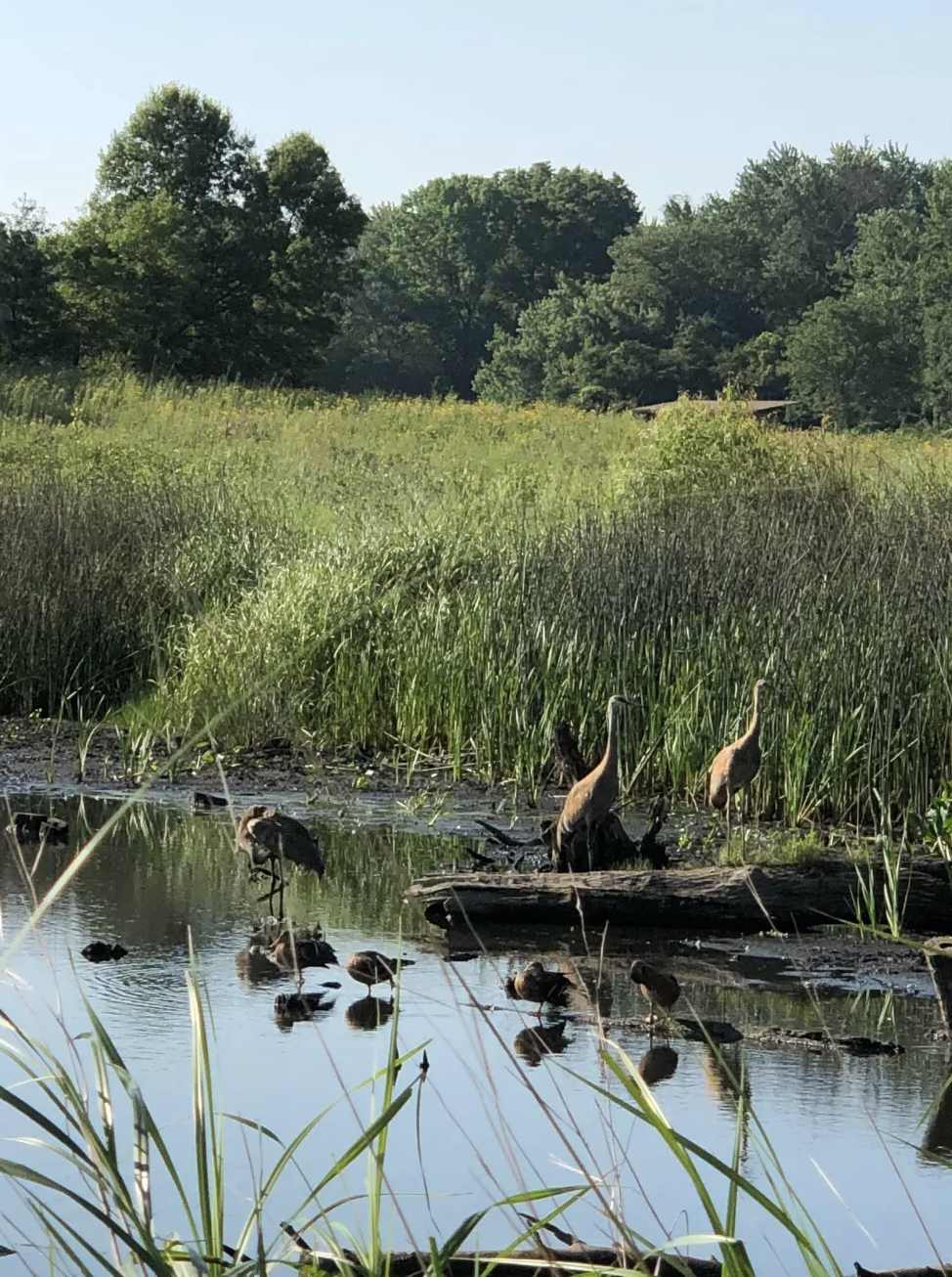
Sandhill Cranes at Deer Grove Forest Preserve
The Forest Preserves of Cook County is a distinctive landscape that brings so much to the community, whether through providing research opportunities, recreational activities, or simply the ability to spend time with nature. On a personal note, my family has deeply enjoyed visiting different parks and seeing the Sandhill Cranes, various woodpeckers, reptiles, amphibians, and other animals that call FPCC their home. Immense thanks to Adam for providing a deeper insight into these preserves we are so fortunate to enjoy. We should do what we can to help the FPCC and build upon the accomplishments already achieved.