
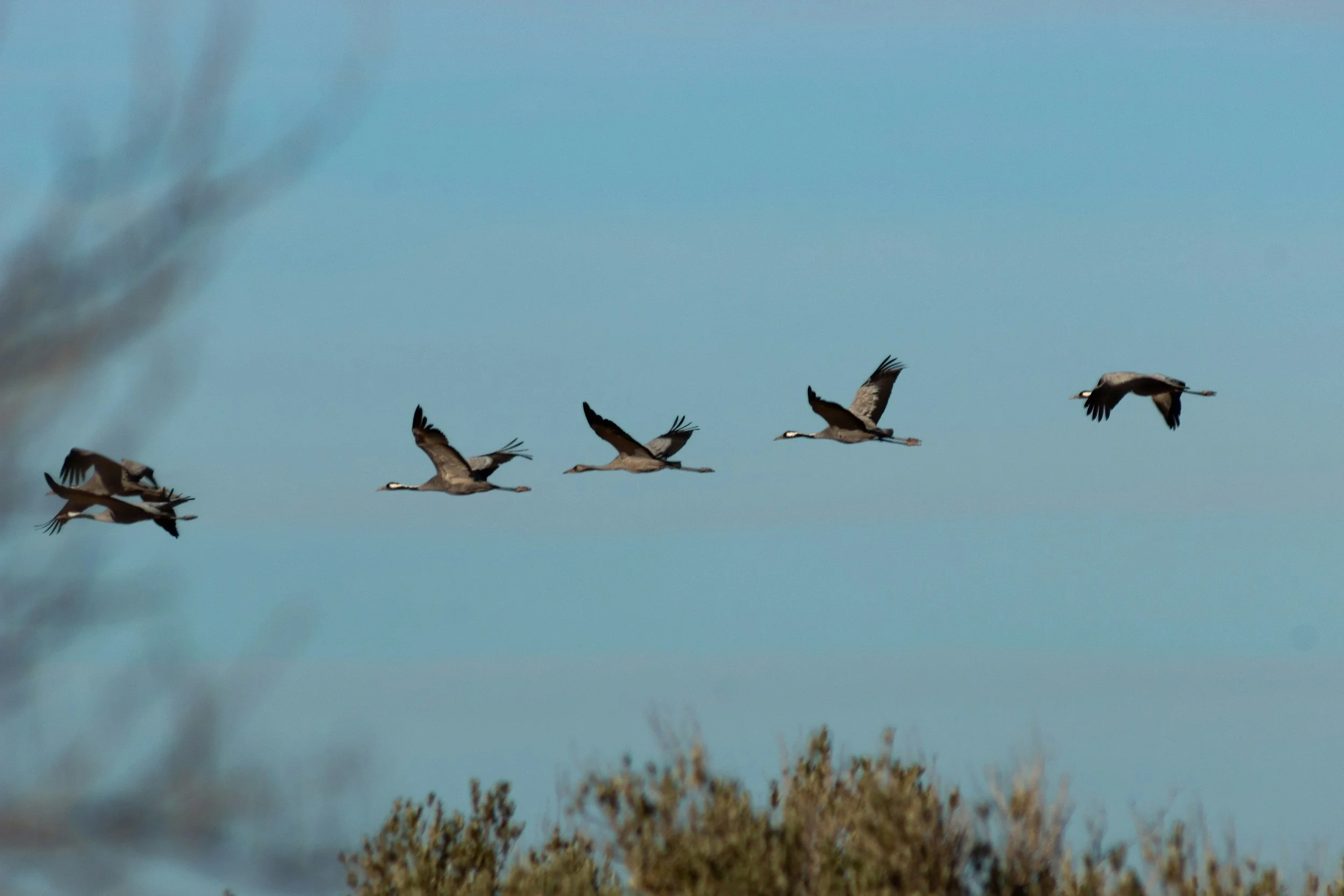
As of early March, spring migration for birds in Chicago is well underway.
According to Chicago Bird Migration Monitoring Network, which uses acoustic monitoring devices and machine learning to automatically detect bird calls, the night of March 3rd recorded an estimated 2321 bird calls. This surge is corroborated by Birdcast, a tool developed by Cornell Lab of Ornithology. Birdcast uses the U.S. weather surveillance radar system to detect nocturnal bird migration, offering open platform tools for migration forecast and live local migration alerts. On the night of March 3rd, Birdcast estimates 3000 birds crossed Cook County.
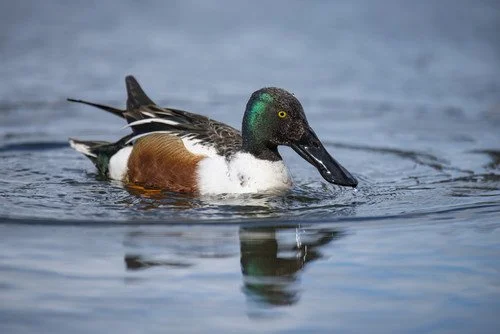
Northern Shoveler, Lincoln Park, Chicago, Illinois
Russ Smith/Audubon
Ducks are usually the first to migrate. Northern Shovelers can be seen in Chicago from March to early May.
Spring migration season in Chicago typically goes from mid-March to early June, peaking around mid-May. People have observed that migration season has been happening earlier, although scientists are still studying the extent of bird migration flexibility. With bird migration season ramping up soon, here are some things you can do to help make their travel through our city safer.
Lights out!
Below is adapted from a 2024 article on the CBA blog
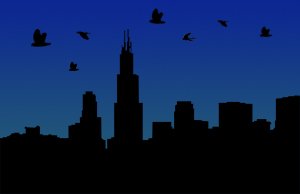
Tall buildings can save many birds by extinguishing decorative lighting on the upper stories after 11 p.m. each evening and leaving lights off until daylight from March 15 to June 15 for the spring migration, and again from August 15 to November 15 for the fall migration. Birds migrate throughout these months. Tenants on the upper floors are encouraged to turn out lights or draw blinds after 11 p.m. These recommendations apply to all buildings of 40 or more stories and to buildings of 20 or more stories that are isolated from other buildings.
Short buildings along the lakefront (with extensive glass exteriors) can save birds by extinguishing exterior lighting and extinguishing interior lighting or drawing blinds from March 15 to June 15 each evening after 1 a.m. and from August 15 to November 15, leaving the lights off until daylight. Buildings with lighted atria can save birds by reducing atrium lighting in the early morning hours.
Chicago Bird Collision Monitors
Based on new research, we recommend that during the Lights Out migration periods, lights be turned off (or blinds drawn) in all perimeter office and residential spaces on all floors from 4 am to full daylight. Birds that are decreasing their elevation to settle in to rest, after their long migratory journey, will have a reduced risk of colliding with windows.
Lights Out Chicago is a program of the Chicago Bird Alliance, the Building Owners and Managers Association of Chicago, and Chicago Bird Collision Monitors. You can learn more about the program here.
Monitor Bird Collisions
Chicago Bird Collision Monitors train and organize volunteers to rescue and collect injured and dead birds. Sometimes the fallen bird you find on the side of a building may still be alive, and timely rescue could set it on its way again. If you find an injured bird, call 773-988-1867 to contact Chicago Bird Collision Monitors. They will coordinate with you and send help your way. They also collect dead birds and transfer them to the Field Museum for documentation, research, and educational purposes.
Record Your Observations
Recording your observations of migrating birds on platforms such as eBird and iNaturalist help contribute to an open source data pool. These community-built data sources can supplement institutionally collected data to aid scientists studying the matter. (It is also another fun way to get involved!)
Following the above steps can support a better spring migration for birds, while also allowing birders and ornithologists to observe many migratory birds pass through Chicago safely. Happy Spring Birding!
Sources
Chicago Bird Migration Monitoring Network, https://www.migrationbiology.org/chicago-bird-migration-monitoring-network
Birdcast, https://dashboard.birdcast.org/region/US-IL
Spring Migration, https://www.chicagobotanic.org/birds/spring-bird-migration
Northern Shoveler, https://www.chicagobotanic.org/birds/shoveler-northern