

We know that Mother Nature follows her own calendar of the seasons, and has no need for our human holidays to mark the entry of spring in the Northern Hemisphere. But, if she were to put together an Easter Basket, what eggs might we find in it?
A quick history lesson concerning eggs and Easter
Easter is a Christian holiday, but many of its customs are pagan, or pre-Christian. Many cultures, such as in ancient Egypt, Persia, and the Roman Empire, included gifts of eggs in celebrations of fertility, renewal and the changing seasons. Anglo-Saxon festivals in the spring celebrated the pagan goddess Eostre; some historians believe Eostre, who represented the dawn in spring, is the namesake of Easter. As part of the celebration of Eostre, eggs were buried and eaten as they represented new life after winter. Early Christians adapted this symbolism to their rites, linking eggs (and rebirth) with the resurrection of Jesus Christ. Decorating eggs dates back to at least the 13th century. Eggs were formerly forbidden during Lent, included with meat and all animal products. To mark the end of Lent, and the practice of penance and fasting, people would decorate eggs and then eat them on Easter as part of the celebration.
How did those eggs get in a basket? And why is a rabbit involved? Baskets are how most smaller goods were transported by hand, and the rabbit – that is a more recent addition to Easter traditions. Probably because of their abundant procreation, rabbits (hares in Europe) have been associated with spring. Their ability to “lay eggs,” and thus their association with Easter eggs has a fairly muddy, and possibly very convenient, 19th century explanation: “The hare was originally a bird, and was changed into a quadruped by the goddess Ostara (Eostre); in gratitude to Ostara or Eastre [sic], the hare exercises its original bird function to lay eggs for the goddess on her festal day."
In the United States, those celebrating Easter dye the boring, white, store-bought hens’ eggs in different colors and patterns (and by the way, different varieties of chickens lay different colored eggs, including blue, green, pink, purple, and chocolate brown). What eggs might we find in the natural world that would liven up an Easter basket?
Briefly, the how of colored eggs
In the 19th century, scientists started studying the chemistry of eggshell color, but it was not until the 1970s that it was determined that there are only two pigments that create the array of colors and markings. Protoporphyrin IX produces reddish-brown colors. Biliverdin produces shades of blue and green. Using a color-mixing computer model, researchers have been able to create the varied colors of eggs found in nature; for example, a lot of biliverdin with a tad of protoporphyrin produces a light, bluish-green.
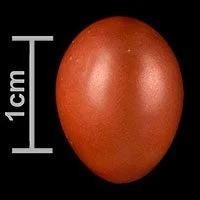
Cetti’s Warbler eggs are an intense brick-red – solely protoporphyrin pigment. Photo by John Weinstein, © 2014 The Field Museum.
How are those pigments applied? Zoologist Tim Birkhead describes the pigmentation process as an array of “paint guns.” Within the bird’s uterus each “gun” is genetically programmed to fire at a certain time so that the signature background color and spotting of a species’ eggs is produced. Color is applied very shortly before the egg is laid.
The eggshells of some bird species contain color throughout the major layers of the shell, even the shell membrane, while in others only the cuticle, or the very outer part of the shell, is colored. And then there is glossiness, personified most by the eggs of the Tinamou family. Besides eggshells of spectacular colors, these birds lay eggs that are very glossy. Turns out this is the result not of pigment, but the nanostructure of the cuticle. Unlike the slightly rough, bumpy contours of most eggshells, the very outermost layer of Tinamou eggshells is so smooth it has a mirror-like sheen, reflecting light. Egg coloring intensity is also dependent upon the richness of the mother bird’s diet, as well as the sequence of laying.
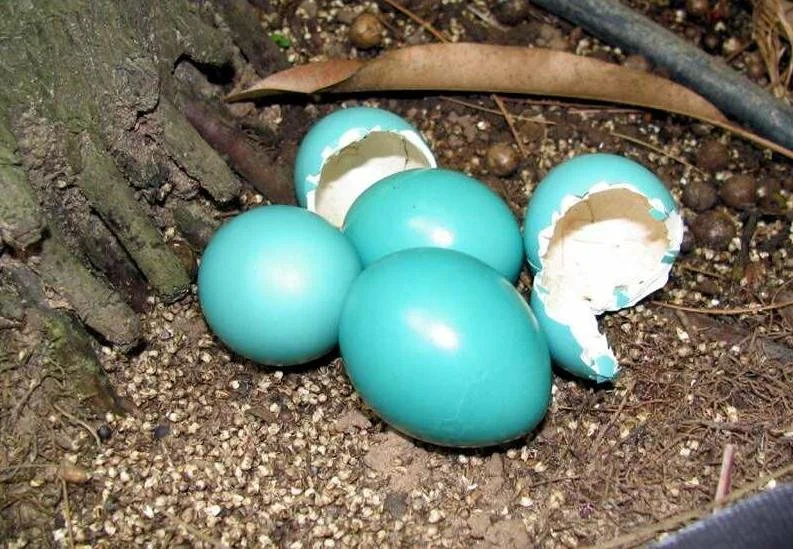
Eggs of the White-throated Tinamou. https://commons.wikimedia.org/w/index.php?curid=64914, Marcos Massarioli
The why (or why not) of colored eggs (and we still don’t know)
For many birds, the coloring serves as camouflage. Many birds that nest on the ground lay eggs that are streaked, spotty and tan, and thus blend in with rocks and sand. Our Great Lakes Piping Plovers are prime examples. And generally, birds that nest in cavities tend to lay all-white eggs. Since the eggs are hidden, there’s no need for camouflage. There are, however, dramatic exceptions. The afore-mentioned Tinamous in Central and South America lay their eggs in leaf litter on the ground, where the eggs can often be quite obvious. One theory is that the birds are using the bright egg color to signal other females to encourage synchronous laying. The females of most species of Tinamous mate with more than one male, and lay eggs in different nests. The male incubates the eggs, and may have eggs from up to four females under him. The more eggs total, the more likely your egg will survive predation. But even if the eggs are in a nest, somewhat hidden from view, why pick Robin’s egg blue for an egg color? It’s theorized that the brighter color of American Robin’s eggs, for example, may make them more prone to predation, and thus the male Robin of the pair increases his investment in the care and protection of the nest. Similarly, more brilliant egg color may indicate the overall health and quality of the female, and so again the male assists more actively in caring for the clutch.
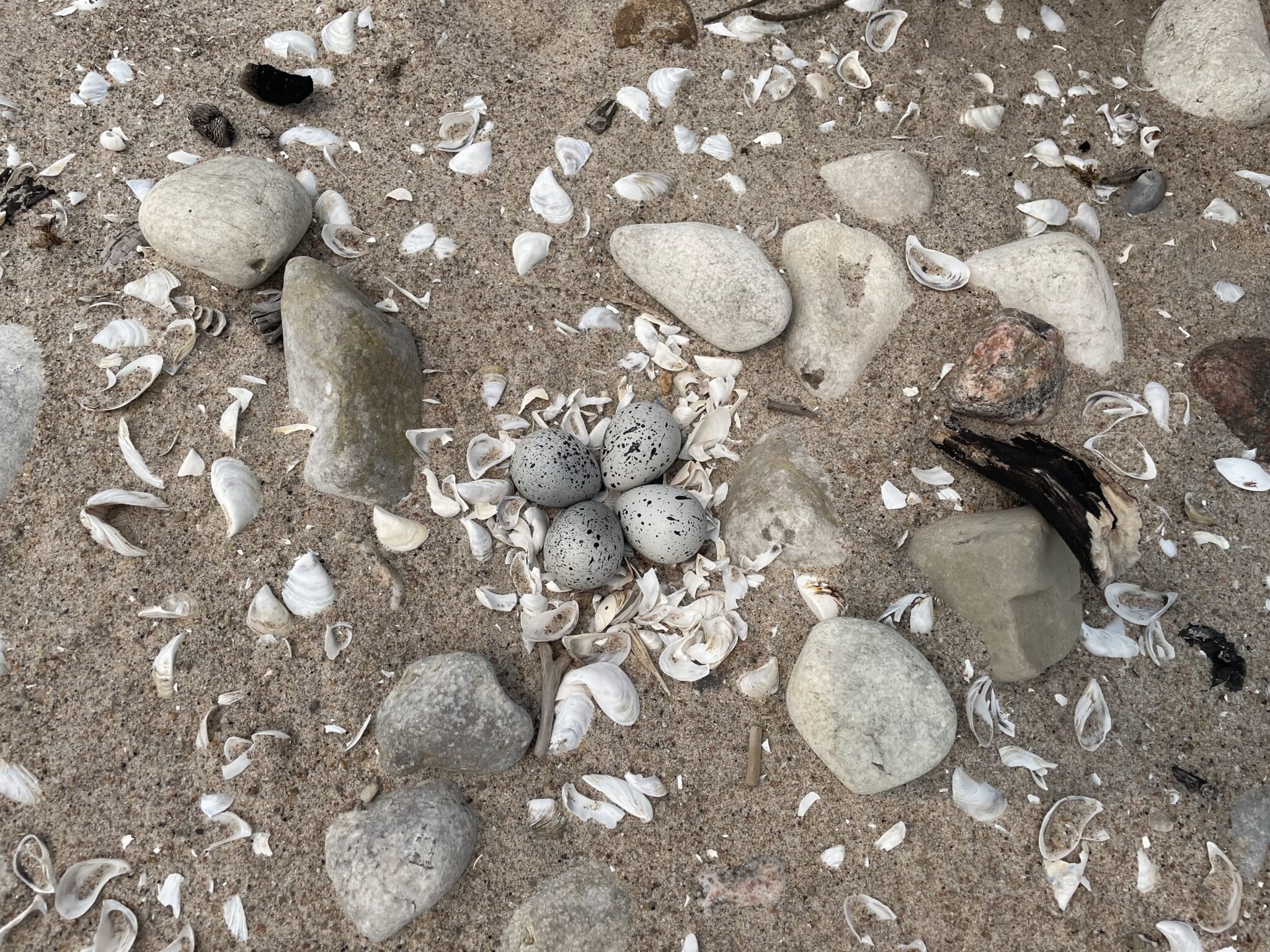
Great Lakes Piping Plover eggs. Birds Canada
Eggs that are colored may also have greater protection from DNA-damaging ultraviolet radiation – but conversely that color may raise the temperature inside the egg and harm the developing embryo. The amount of egg color, daytime temperatures, whether predation is likely, and typical nest location for a species are all factors that are being studied in relation to eggshell color.
Mom always loved you best
The squiggles, spots, and shadings of eggs help to camouflage them from predators, but they also serve as unique name-tags for eggs that are one of many – think of large nesting sites of colonial nesters such as terns and gulls. Some colonial nesters do not even build a nest, such as some guillemots, and so can’t use the structure of a particular nest to help locate their egg. Studies have found guillemots can distinguish their own egg from a foreign egg, using coloring and markings as a guide. Where egg recognition also comes in handy is in the case of conspecific brood parasitism, which is parasitism by your own species. Studies of American Coots in British Columbia found that host mothers buried to the nest floor, or ejected, American Coot parasitic eggs, demonstrating that they are indeed able to recognize their own eggs.
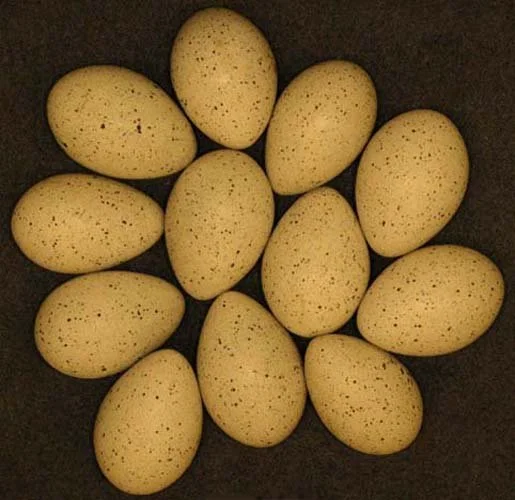
Altogether, we don’t really know completely why bird eggs are colored, or have a particular pattern, but with research it is possible to conjecture the survival advantages of such markings.
Local Easter basket
In a completely imaginary locally-sourced Easter basket, what colorful eggs could we add? We could have blue-green eggs from American Robins and Gray Catbirds. We could have eggs that are light tan or creamy, with brownish speckles from Caspian Terns and Black-capped Chickadees, even bigger spots from the Eastern Kingbird, a band of spots from the Eastern Wood-Pewee, heavily streaked from Great Crested Flycatchers, and big black spots from the Killdeer. Our basket could be rounded out with reddish eggs from Peregrine Falcons and American Kestrels.
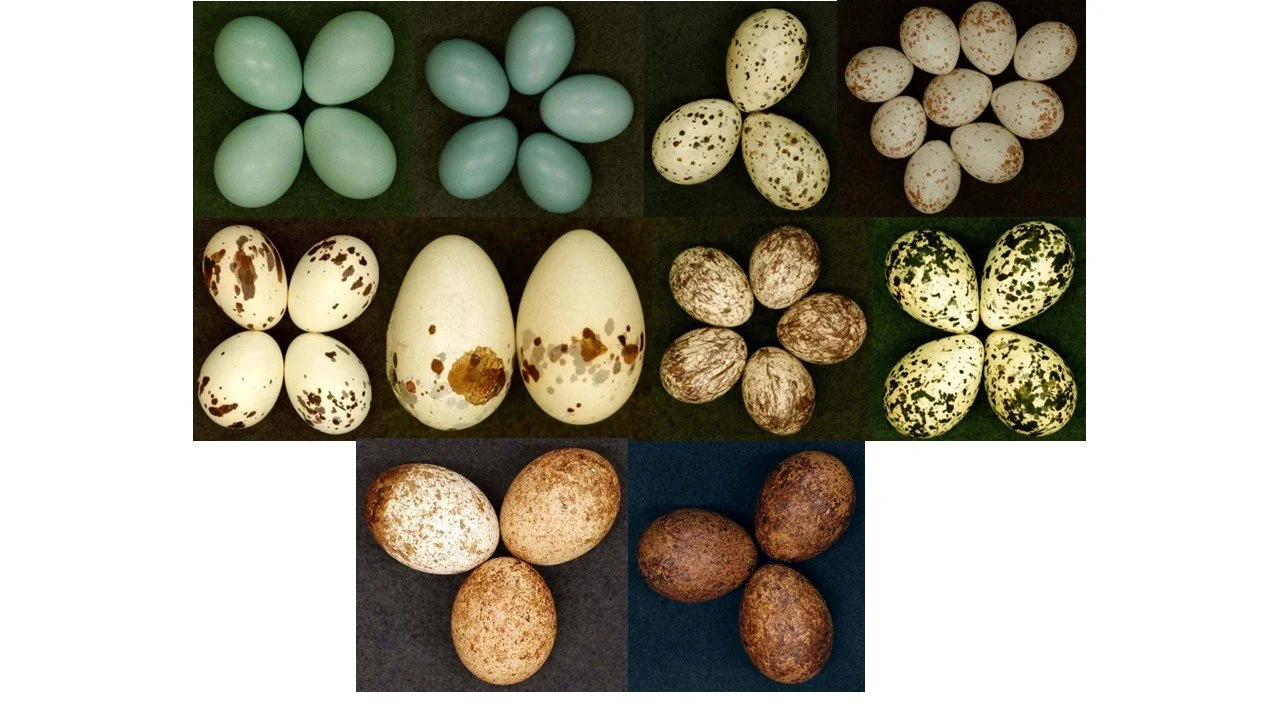
Eggs from (top row) American Robins, Gray Catbirds, Caspian Terns, Black-capped Chickadees (middle row) Eastern Kingbirds, Eastern Wood-Pewee, Great Crested Flycatchers, Killdeers (bottom row) American Kestrel, Peregrine Falcon. https://www.uwgb.edu/richter-museum/birds/
Celebrate your spring holidays with a birding outing, but always respect the privacy of any nesting bird. For a fun introduction to bird eggs, check out the Field Museum’s collection with John Bates!
Sources:
https://www.thepioneerwoman.com/holidays-celebrations/a64075538/easter-egg-origins/
https://www.foodrepublic.com/1509437/why-eggs-forbidden-during-lent-history/
https://www.history.com/articles/easter-symbols
https://en.wikipedia.org/wiki/%C4%92ostre
https://www.allaboutbirds.org/news/the-beauty-and-biology-of-egg-color/
https://www.phipps.conservatory.org/blog/detail/biopgh-blog-colorful-eggs-in-the-spring
https://www.audubon.org/news/cracking-code-egg-coloration
https://physicsworld.com/a/nanostructure-puts-the-gloss-on-avian-eggshells/
Birkhead, Tim. The most perfect thing: inside (and outside) a bird’s egg. Bloomsbury USA, 2016.
https://www.uwgb.edu/richter-museum/birds/ Database of birds likely to breed in Wisconsin
Header Photo: https://commons.wikimedia.org/wiki/File:Easter_gets_closer_-_Flickr_-_ernstkiessling.jpg, Ernst Kiessling
