
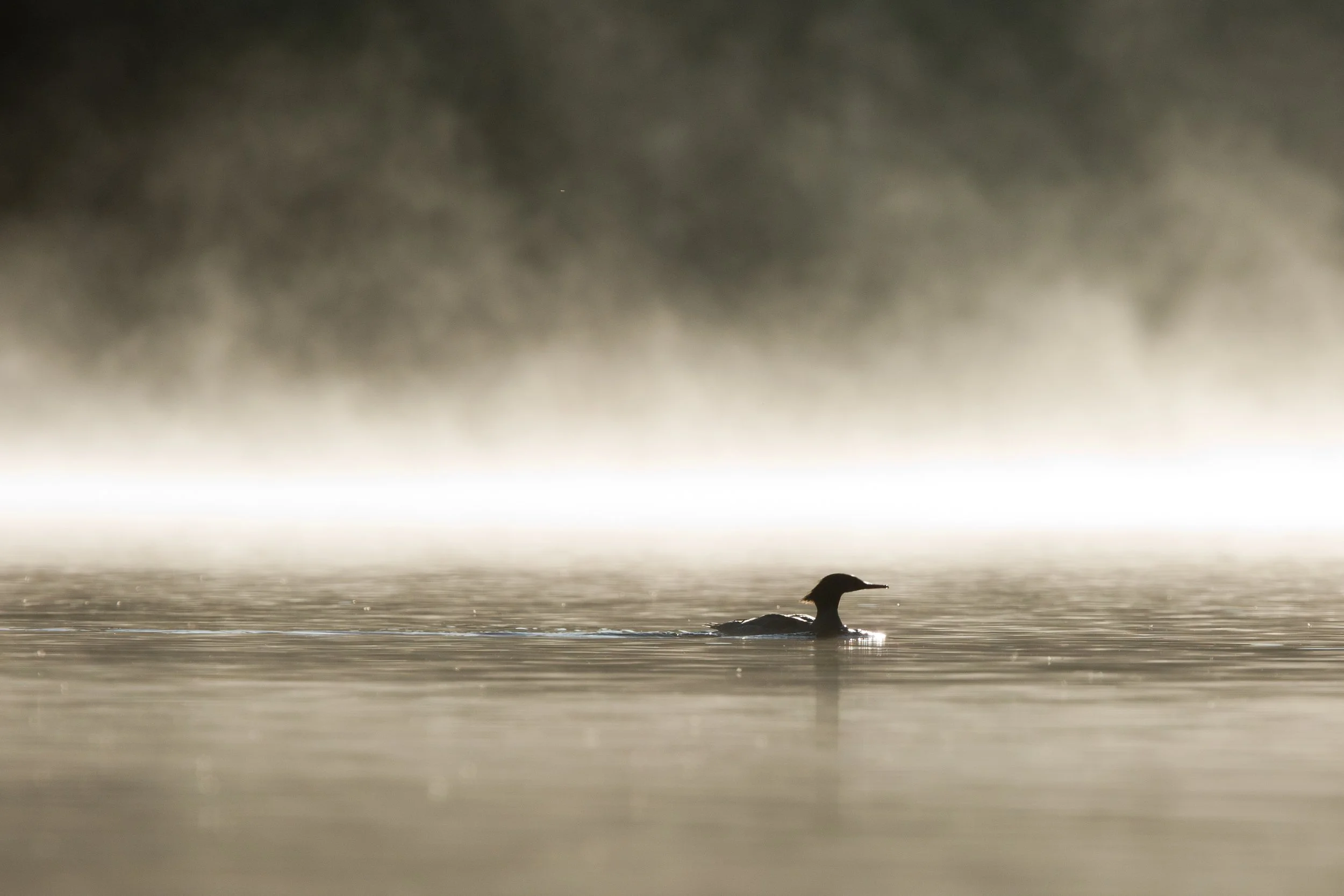
Pine silhouettes gathered the first light along their edges, and the morning seemed suspended between night and day. The surface lay still, holding its breath. I arrived at dawn, before the park’s quiet would yield to footsteps and voices, hoping to encounter the birds in the brief hour when the lake still belonged to them. The wind was mild, the lake placid. I let the kayak glide into the water and moved slowly toward the open stretch where the heron sometimes stands, poised and intent at the marsh’s edge.
Ahead, another kayaker drifted motionless and lifted his hand toward the distant water. There, a pair of mergansers glided across the open lake. They rode low and alert, their bodies aligned with the water’s quiet demeanor. The male’s iridescent, disheveled head caught the rising light; the female followed close behind, composed and dignified. Even at a distance, their presence felt deliberate — another wondrous creation shaped by depth and motion. Without hesitation, they dove with swift precision, vanishing beneath the surface and rising again yards away, moving between air and water as if the boundary between worlds did not exist.
Diving birds have long stirred human imagination. In some Indigenous traditions, water birds who plunged to the depths were said to bring up earth itself, shaping land from water. Whether myth or metaphor, the image endures: life sustained through descent, through movement between elements. Mergansers, nesting in tree cavities yet hunting in deep water, embody that threshold — creatures at home in air, wood, and depth. It is not surprising that some cultures regarded such birds as figures of transformation, mediators between realms.
Yet perception has never been singular. In certain fishing communities, mergansers were seen not as symbols but as competitors — consumers of trout and salmon, targets of eradication in the name of protecting stocks. The same bird could inspire reverence in one tradition and resentment in another. Such tension reflects the broader human struggle to balance livelihood with coexistence.
In modern ecology, mergansers carry another meaning. Feeding heavily on fish and standing near the top of the aquatic food chain, they are especially vulnerable to pollutants — mercury, pesticides, unseen toxins that accumulate quietly. Their presence suggests clarity and abundance; their absence can signal imbalance long before the eye detects it. At dawn they seemed less like ordinary waterfowl and more like quiet sentinels — creatures fluent in air and depth, reminding us that the health of water, and perhaps our own survival, depends on what flows unseen beneath the surface.
For a few minutes, the lake belonged entirely to them — no voices, no clamor, only water, light, and the quiet discipline of survival. Then, as the sun climbed and distant sounds began to stir along the shore, they lifted from the surface and flew low across the water, wings beating cleanly against the morning air. I remained still, aware that what I had witnessed required little more than patience — and a willingness to arrive before the day claimed the lake for itself.
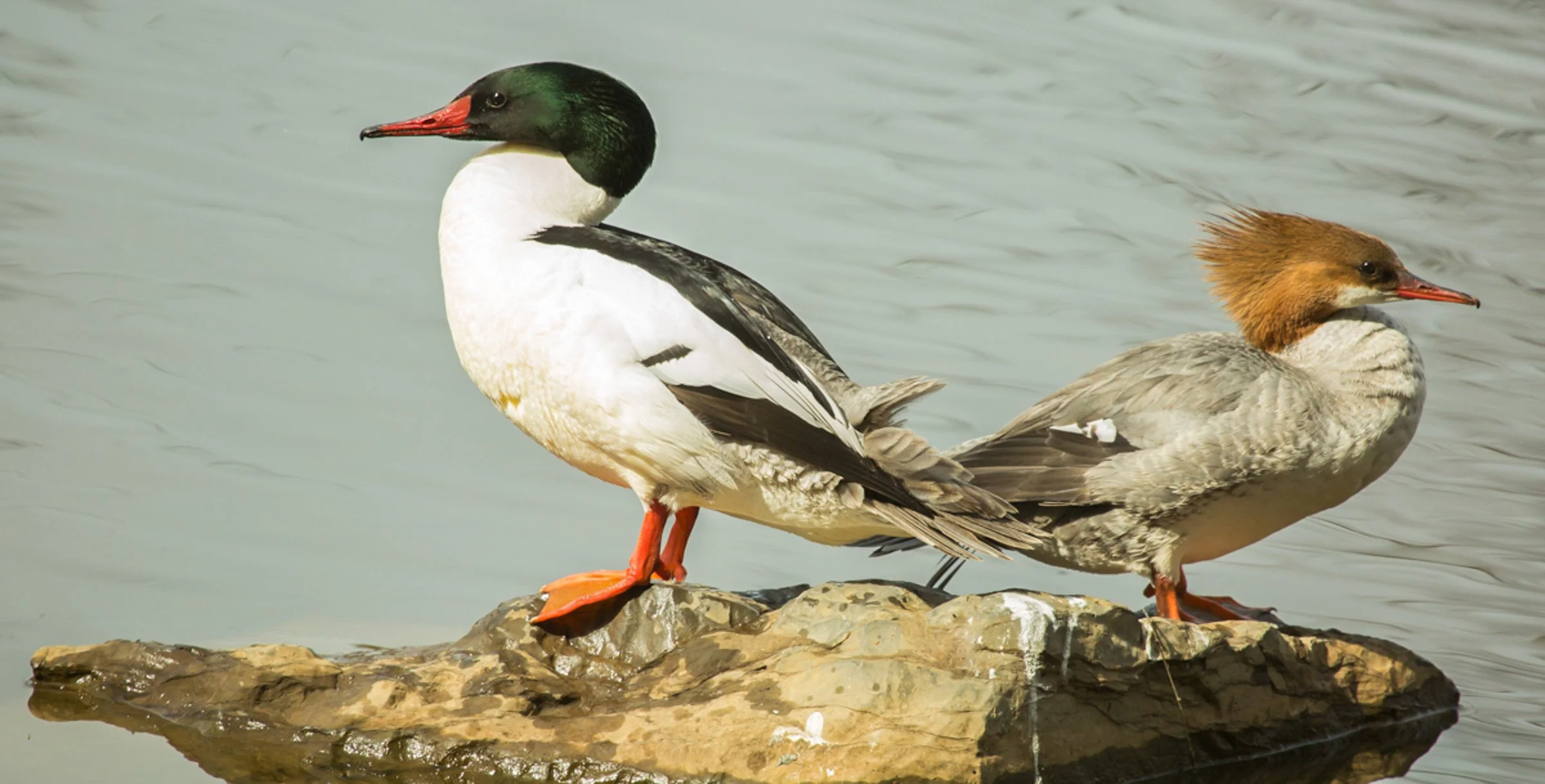
Male and female Common Mergansers by Gail Norwood/Audubon Photography Awards
About the Author
Sepala Weliwitigoda is a published author, poet, and essayist whose writing on birds and wildlife has appeared in several Audubon chapter newsletters and conservation publications. Through field observation, his work explores ecological interconnectedness and the idea of informed reverence for nature — the belief that careful attention to living systems deepens understanding of interdependence and encourages long-term stewardship. His books include Listen to the Songbirds: Meditations on Beauty and Survival and Cat the Sovereign: Poems on Nature, Memory, and Vanishing Worlds.