
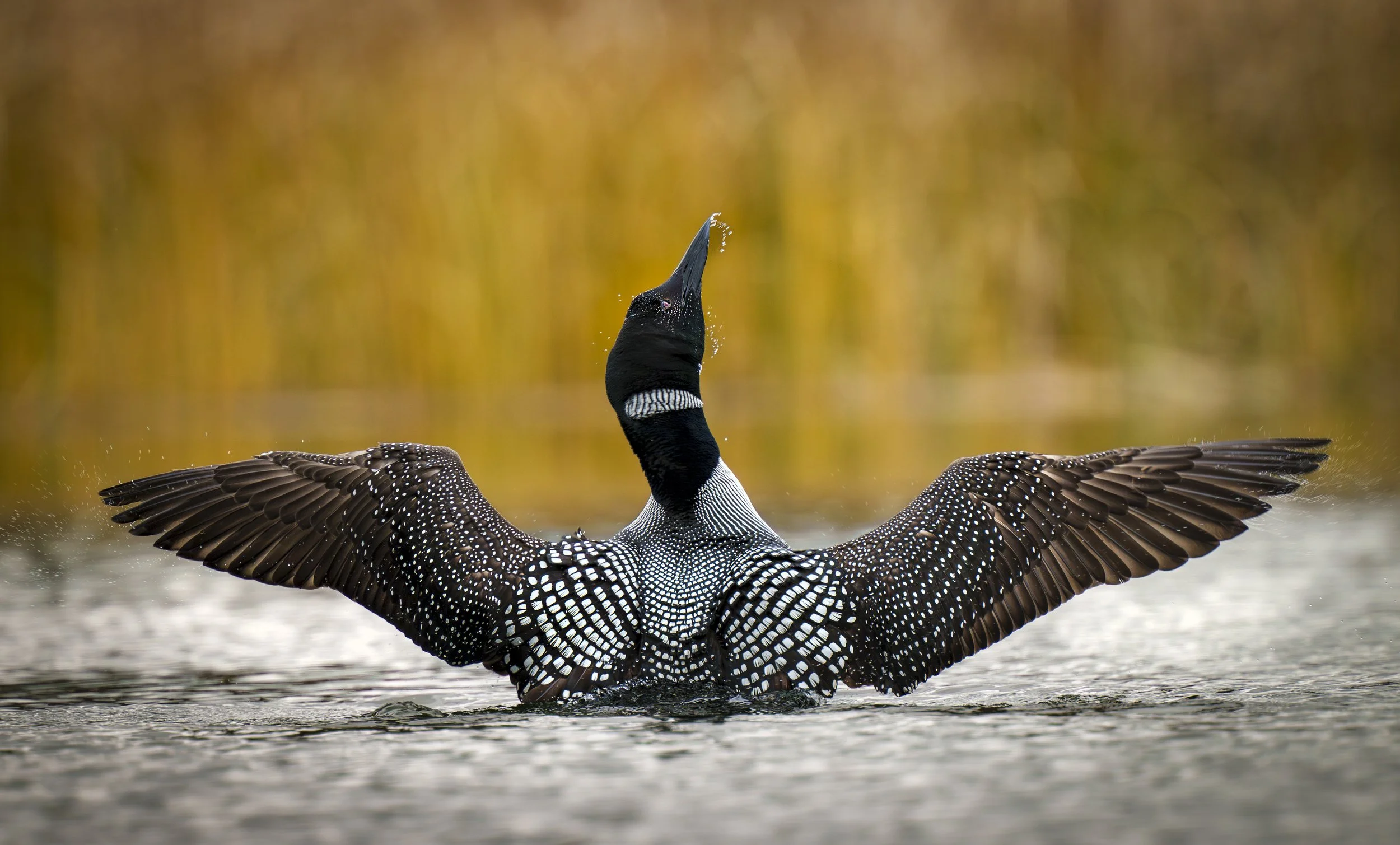
Black and white plumage,
checkered with white spots,
a ruff of lace around the neck—
kings and queens of the lake,
dignified, graceful,
royalty among waterfowl.
Their reserved isolation,
shrill, haunting calls—
the wail, the tremolo, the yodel—
calls of freedom and solitude,
as if nature, in its wisdom,
took extra care with them.
One need not invoke the supernatural to experience the wonders of nature. Certain creatures appear so exquisitely formed, so finely attuned to their environment that they evoke astonishment and quiet awe. The loon is such a bird. Its design, behavior, and haunting calls suggest a presence shaped for open water and wide northern skies. The wail, the tremolo, the yodel—each carries across the lake with a strange clarity, sounding less like simple calls and more like declarations of freedom and solitary independence. To witness a loon is to encounter a creature whose bearing reflects resilience, dignity, and a life lived comfortably at the margins of solitude.
The loon’s calls—the wail, the tremolo, the yodel—carry across open water with an eerie clarity and a singular dignity. They are not simple chirps; they are declarations of solitary presence. The wail, in particular, lingers in the distance, as though summoning attention to its rare presence. The loon’s voice feels less like noise and more like communication from the edge of the distant horizon—a reminder that solitude and aloofness, too, carry authority. The sound commands admiration and leaves an unforgettable image. That emotional imprint stays and lingers.
Among many Indigenous peoples of North America, the loon has long been regarded with particular reverence. Living close to lakes and rivers, these communities observed the bird’s habits with careful attention. The loon’s remarkable ability to dive deeply and reappear far from where it vanished gave it an air of mystery and endurance. In several traditions, the loon appears in stories connected to spiritual resilience, sometimes viewed as a messenger between visible and unseen realms. Its solitary bearing and commanding voice were often associated with watchfulness, dignity, and the quiet authority of the natural world.
In parts of northern Europe, particularly along the coasts of Scandinavia and the North Atlantic, loons were also observed with practical attentiveness. Fishermen and coastal communities sometimes regarded them as living barometers. Their loud wails and restless calling were believed to precede shifts in weather, especially approaching storms or falling atmospheric pressure. Whether the connection was exact or not, generations of observers treated the bird’s voice as a signal that the conditions of sky and sea were changing. Such beliefs reveal how closely earlier societies watched the behavior of animals whose lives were tied to water and wind.
Modern ecological understanding gives the loon another significance. Because loons feed largely on fish and occupy a high position in the aquatic food chain, they are particularly vulnerable to toxins that accumulate in water—mercury, industrial pollutants, and other contaminants that gradually concentrate in fish. Their presence often signals clean, functioning lake ecosystems. Where loons thrive, waters are usually clear, fish populations remain balanced, and shorelines are relatively undisturbed. Where they disappear, the loss frequently points to deeper ecological disturbances long before they become obvious to human observers.
Loons also depend on conditions that modern landscapes increasingly threaten. They require quiet waters, undisturbed nesting sites near shorelines, and lakes where human activity does not overwhelm the natural rhythms of the habitat. Increasing shoreline development and fluctuating water levels can easily disrupt nesting pairs. Even small disturbances during the breeding season may cause adults to abandon nests, leaving eggs exposed to predators.
The loon feels shaped with particular deliberation — asking only that the waters it inhabits remain clear. To watch a loon glide across a quiet lake is to feel a kind of informed reverence—an awareness, shaped by observation and understanding, that the clarity of the water and the presence of such a bird are inseparable. In that awareness lies a quiet responsibility: to keep the waters, shorelines, and surrounding forests healthy enough for the loon’s voice to continue echoing across northern lakes.
To hear a loon at dusk is not only to hear
wilderness—it also suggests a lake still
functioning.
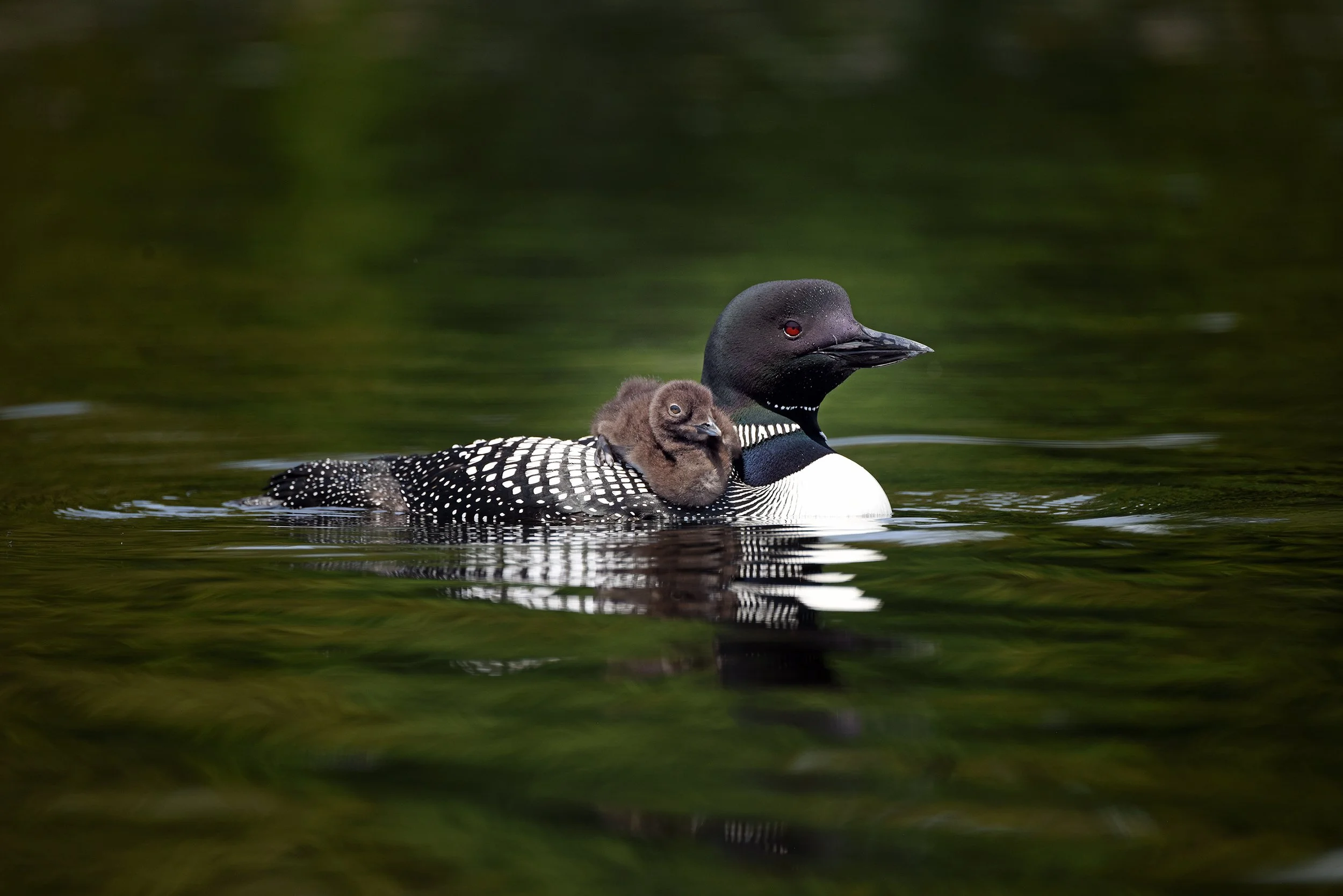
Common Loon, adult and chick by Derrick Jackson/Audubon Photography Awards
About the Author
Sepala Weliwitigoda is a published author, poet, and essayist whose writing on birds and wildlife has appeared in several Audubon chapter newsletters and conservation publications. Through field observation, his work explores ecological interconnectedness and the idea of informed reverence for nature — the belief that careful attention to living systems deepens understanding of interdependence and encourages long-term stewardship. His books include Listen to the Songbirds: Meditations on Beauty and Survival and Cat the Sovereign: Poems on Nature, Memory, and Vanishing Worlds.