

During the end of April and the beginning of May, the Chicago Park District discovered two nesting pairs of Bald Eagles within Chicago city limits, which had each laid a clutch of eggs, resulting in the birth of three eaglets. According to some, this was the first time in over 100 years that Bald Eagles had been born within the city of Chicago. Although these stoic and iconic birds of prey have been sighted throughout Chicagoland and in Illinois for decades, their history in this state goes farther back and beyond, even before Illinois was properly established.
Natural History and Indigenous Beliefs
Bald Eagles, hailing from the Accipitridae subfamily Haliaeetinae within the bird family tree, first appeared in the fossil record of North America during the Late Pleistocene Epoch, roughly 125,000 years ago. Haliaeetinae, or ‘sea eagles,’ consist of two groups: Haliaeetus and Icthyophaga, with Bald Eagles belonging to the former. Their binomial nomenclature, or scientific name in Latin, is Haliaeetus leucocephalus, and their closest relatives include White-tailed Eagles, Palla’s Fish Eagles, and Steller’s Sea Eagles, all of whom live in Eurasia.
While the Pleistocene fossil remains of these early eagles are few, they first appeared in Earth’s geological history at a time in which bird evolution had culminated to closely resemble how modern birds are today. This coincided with mammal diversification reaching its peak, the last Ice Age occurring, and early humans migrating from Eurasia to the Americas via the Beringia land bridge connecting Alaska to Russia. By the start of the succeeding epoch, the Holocene, rising sea levels covered Beringia, cutting North America off from Eurasia. The humans who migrated using the land bridge would establish a new home for themselves, becoming the ancestors of the Indigenous peoples of North America.
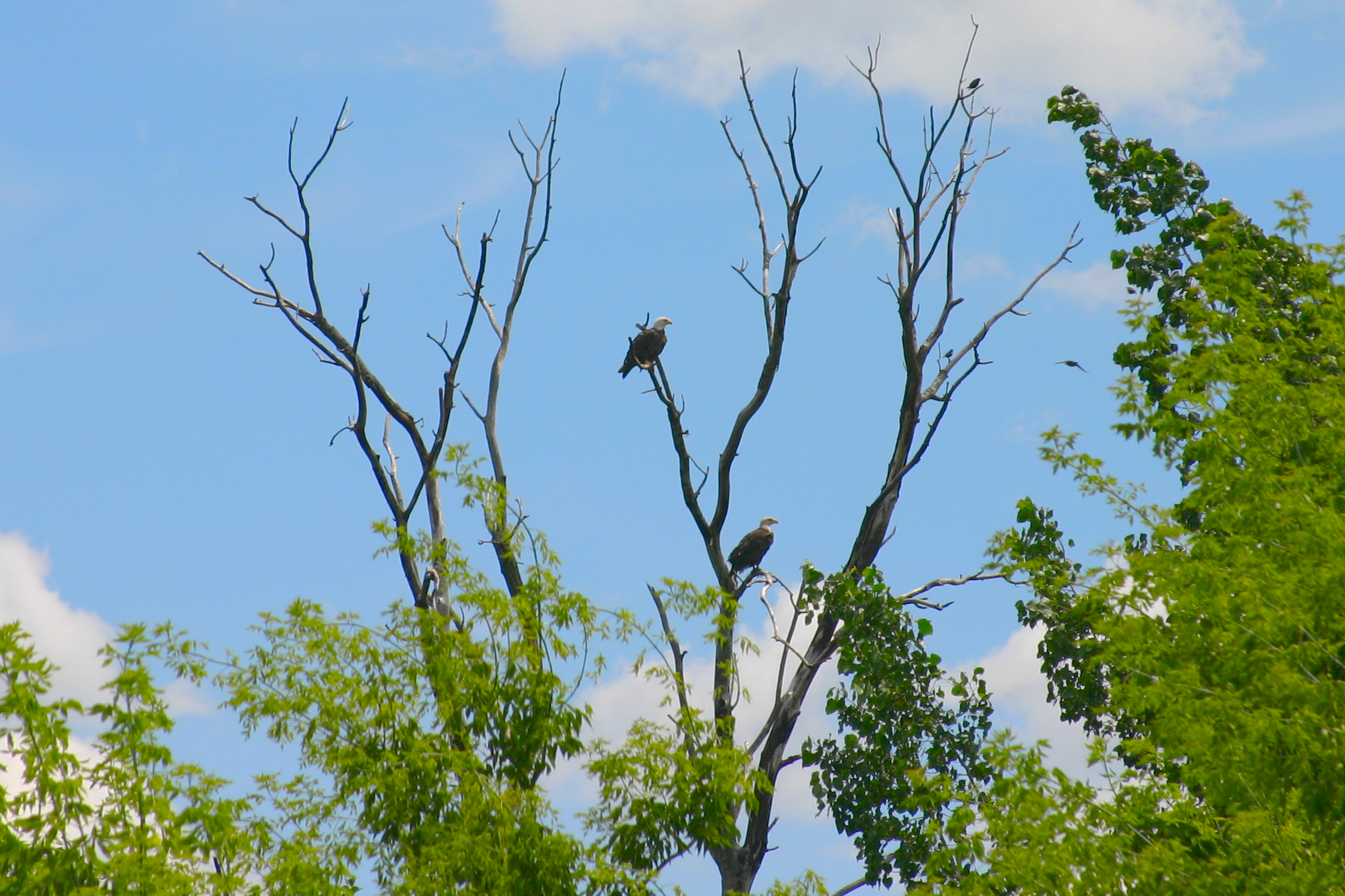
Two Bald Eagles perched on a dead tree on the tip of Cook County in Orland Park, IL. Bald Eagles are monogamous and mate for life. While male and female eagles look virtually identical, females are slightly bigger than males. Photo by Joseph Bruno.
For generations, Indigenous communities across the continent had their own beliefs and interpretations of the Bald Eagle. Some of the beliefs were tied to Indigenous mythological connections to the divine, with Bald Eagles serving as messengers from the spiritual beyond and bridging a connection between the earth and sky, while other beliefs interpreted them as being present during the creation of the world. Bald Eagles may also have been a possible source for the origin of the mythical Thunderbird. According to Indigenous folklore, the Thunderbird was a great spirit that brought thunder with the flap of its wings, representing protection and strength against malevolent spirits, while also serving as a messenger for the Great Sun deity and meting out punishment to those who violated moral codes.
Indigenous communities also include Bald Eagles in ceremonial rituals, dance interpretations, and honorary traditions, some of which involve wearing molted eagle feathers in attire to embody strength, courage, and freedom. Bald Eagles were also recognized with respect as an environmental indicator and were represented in iconography such as totem poles. These are just some of the interpretations used by Indigenous communities across what would become the Chicagoland area, including the Potawatomi, Odawa, and Ojibwe, to celebrate and honor Bald Eagles.
Becoming a National Symbol
Just as this majestic raptor had been revered by the Indigenous peoples of North America, the Bald Eagle would also be memorialized, albeit in a different way, by the European colonists who would establish the United States of America. The Bald Eagle was first used as a symbol on a copper coin created in Massachusetts in 1776, the same year the United States declared its independence from Great Britain. The Bald Eagle would continue to be used on U.S. coins for the next six years, leading up to the debate on what the national emblem should be, with multiple design committees weighing in. The Bald Eagle was suggested as a potential candidate, as was another North American bird—the Wild Turkey—with the latter being viewed as a superior representative of America when compared to the scavenging lifestyle of the Bald Eagle.
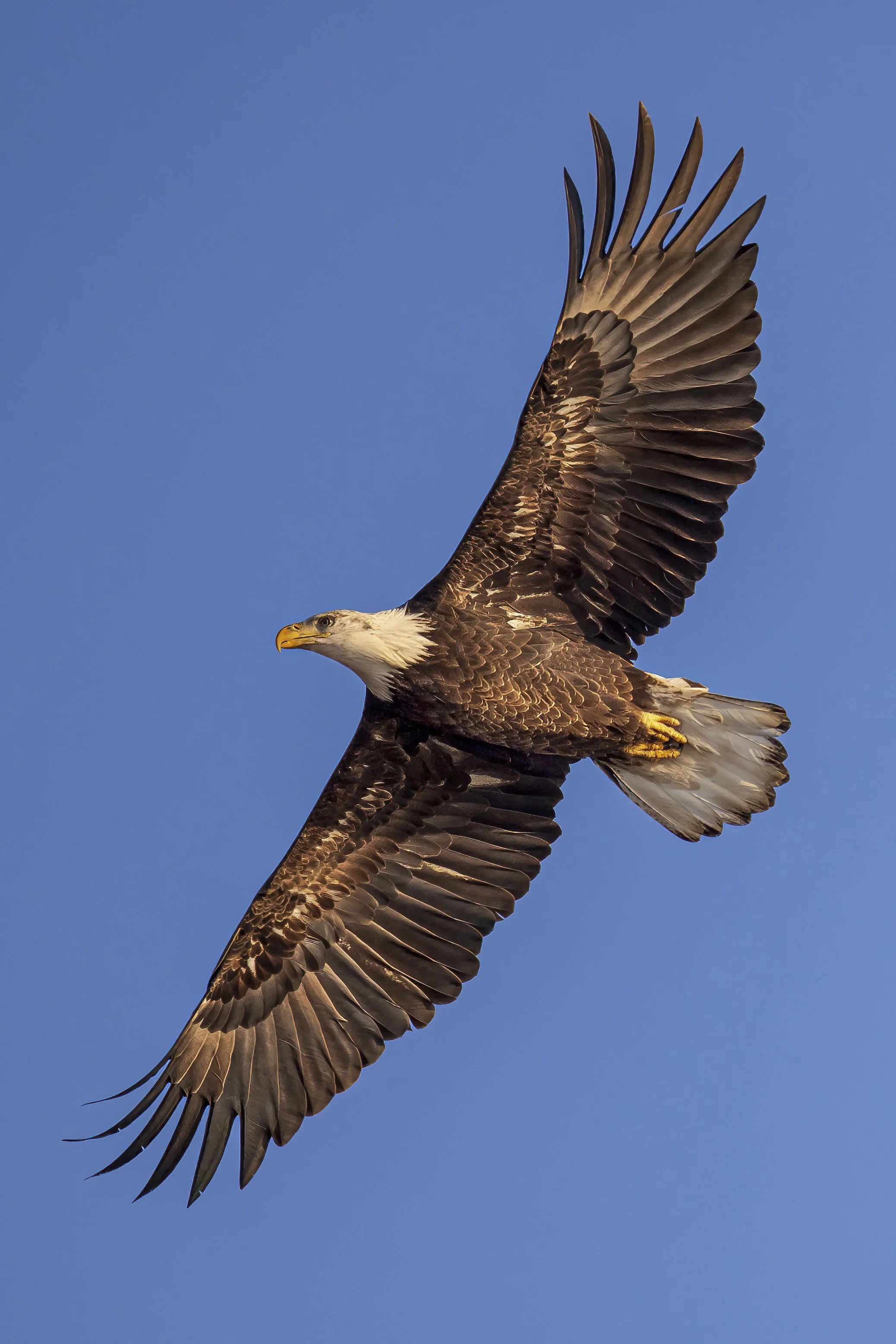
An almost fully mature Bald Eagle flying above Whalon Lake in Naperville, IL. It takes juvenile eagles almost 5 years for their head and tail feathers to turn completely white. Photo by Don Cochrane.
Ultimately, it was decided on June 20, 1782, that the Bald Eagle would serve as the national emblem for the United States, and it was eventually adopted as the national bird in 2024. This date is commemorated as National American Eagle Day. Like the Indigenous communities of America, European colonists viewed the Bald Eagle as a symbol of courage and freedom, which was a contributing factor in the decision to make it the nation’s emblem.
Reaching the Brink of Extinction
Historical reports describe roughly 100,000 nesting pairs of Bald Eagles in North America following the establishment of the United States, but they became threatened due to hunting, habitat destruction, and poaching by farmers, fishermen, and gamekeepers towards the mid-to-late 1800s. The last reported sighting of a Bald Eagle in Chicago was in 1900, with no individuals seen nesting around the city for over a century thereafter.
By the 1940s, Bald Eagle populations in Illinois and across the country began to decline even further than before, as there were only roughly 500 nesting pairs left by that time. It was discovered that eagle eggs were being laid with unnaturally thin shells that could not support the embryos, resulting in fewer successful clutches of eaglets being born. This reproductive collapse was caused by the spread of DDT (dichlorodiphenyltrichloroethane) pesticide, which was used to reduce insect-borne diseases and control insect populations on crops and livestock.
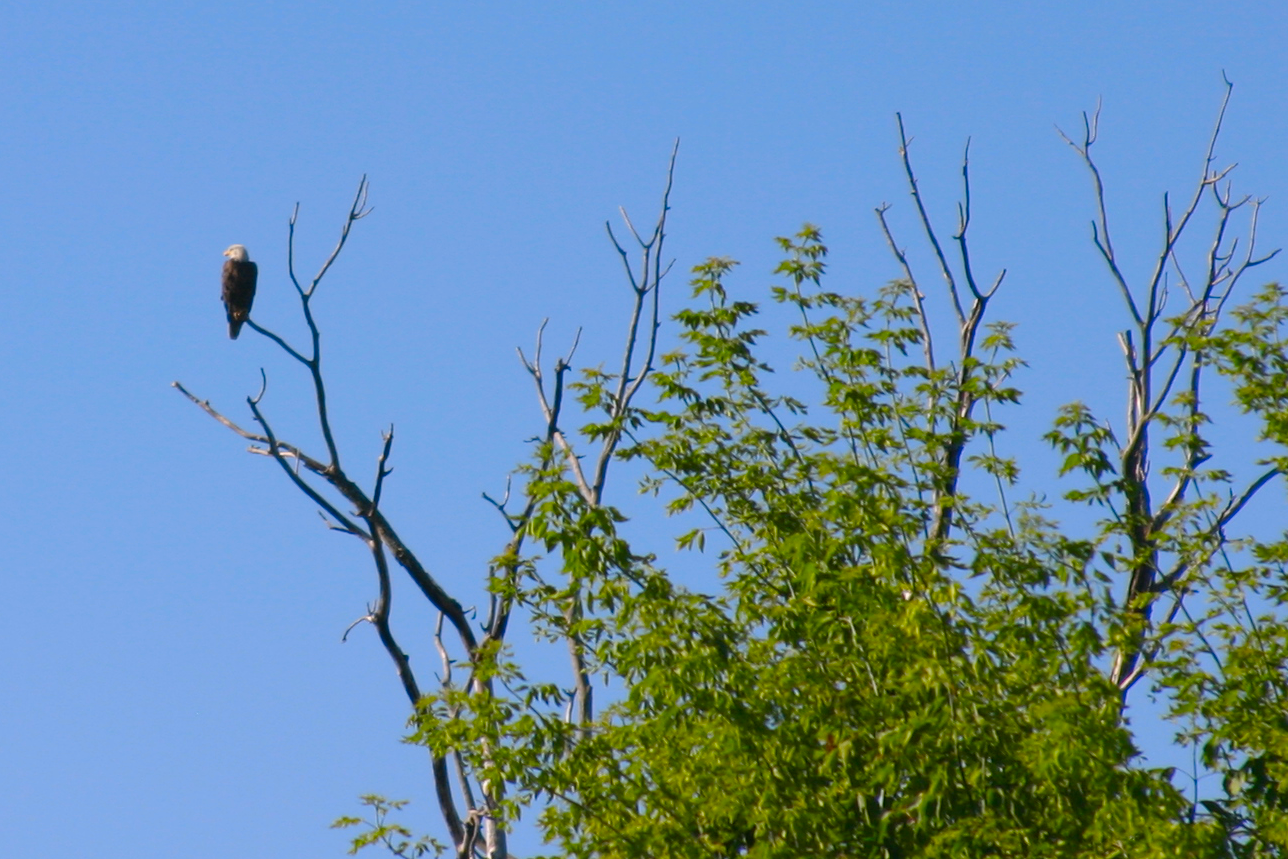
A lone Bald Eagle perched on a dead tree in the early morning in Orland Park, IL. The best time to observe Bald Eagles is during the morning and afternoon, especially during sunrise. Photo by Joseph Bruno.
Unbeknownst to many, DDT was actively poisoning natural habitats, including those of Bald Eagles, as well as other birds. The pesticide trickled down from the crops and livestock into waterways and was absorbed by the fish that make up most of the Bald Eagle’s diet. The very bird that had been symbolic across North America for centuries was being poisoned as a result, becoming critically endangered and running the risk of extinction.
Conservation and Recovery
When reports of the Bald Eagle facing extinction reached the United States government, Congress acted by passing the Bald Eagle Protection Act in 1940, later adjusting it in 1962 to include Golden Eagles (a distant relative of Bald Eagles that belongs to the group Aquila, or ‘true eagles’), and renaming it the Bald and Golden Eagle Protection Act. This act made it illegal to kill, sell, or possess a Bald Eagle, along with making it illegal to disrupt nesting sites. This, however, did not stop the poisoning of Bald Eagles from DDT. It wasn’t until 1962 that the pesticide was called out for the harm it causes to the environment, as detailed in the book Silent Spring by conservationist author Rachel Carson.
As a response to the growing concerns of DDT’s negative impact on wildlife, Bald Eagles were among the first species to be protected under the Endangered Species Preservation Act in 1966. While the U.S. Environmental Protection Agency eventually banned the use of DDT in 1972, roughly three decades of pesticide poisoning had contributed to an already declining population, leading the U.S. Fish & Wildlife Service to list the Bald Eagle as endangered in the lower 48 states of the country in 1978.
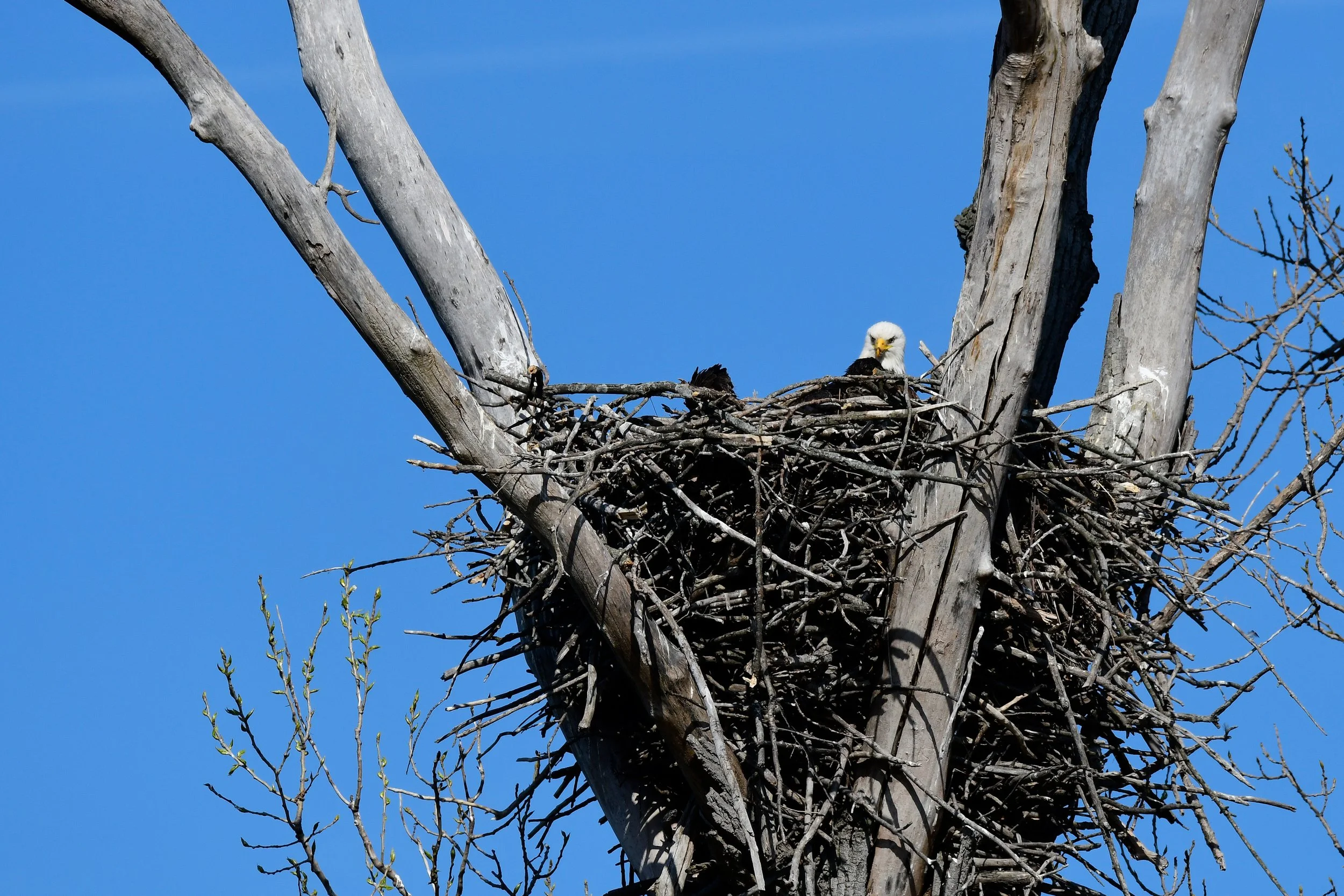
A Bald Eagle nest in Horseshoe Lake State Park, IL. Note the juvenile partially visible to the left of the parent. Photo by Barbara Polahar.
Because of these protections, DDT levels began to fall. As their natural habitat and remaining nesting sites became protected and restored, the number of Bald Eagles rebounded, with more nesting pairs slowly rising across the country. Regarding Illinois in particular, there was only one Illinois county with recorded Bald Eagle nests following the banning of DDT between 1975 and 1980, located on the southern tip of the state. This rose to 14 counties with recorded nests by 1992, and roughly 47 counties by the 2000s, with the eagles gradually moving north and reclaiming lost territory.
However, no nests were recorded in Cook County—the heart of Chicagoland—until 2004, when, for the first time in roughly 100 years, a Bald Eagle nest was confirmed to have been built within Chicago city limits, near the Little Calumet River. However, no eggs or young were ever reported. It wasn’t until 2008, one year after Bald Eagles were taken off the Threatened and Endangered Species List, that Cook County was noted as having active eagle nests, along with 66 other Illinois counties.
Returning to Chicago
Nearly 20 years later, Bald Eagles are more commonly sighted in Chicagoland. In 2022, the U.S. Fish and Wildlife Service reported 35 active nesting sites in the six counties surrounding the city of Chicago, with Bald Eagles returning to these sites year after year. According to eBird, observations of Bald Eagles in Cook County have reached at least 13,000, with these amazing birds sighted year-round. The highest frequency occurs between Fall and Spring, as the colder wintering months are some of the best times to see eagles active in their natural habitat.
Because of the Des Plaines River, Lake Michigan, and other bodies of water sprinkled throughout Chicagoland, this region is a perfect nesting spot for Bald Eagles, given their primarily fish-based diet. Some of the best spots to see Bald Eagles in Chicagoland include Starved Rock State Park in Oglesby, IL, Midewin National Tallgrass Prairie in Will County, IL, and Plum Island Eagle Sanctuary not far from Starved Rock. All of this has culminated in the first reported eaglets born within Chicago city limits in over a century. Two of the baby eagles were recently named Migizi and Marian following a public naming contest held by the Chicago Park District. Migizi was named after the Ojibwe word for Bald Eagle, while Marian was named after Chicago environmentalist and civil rights activist Marian R. Byrnes.
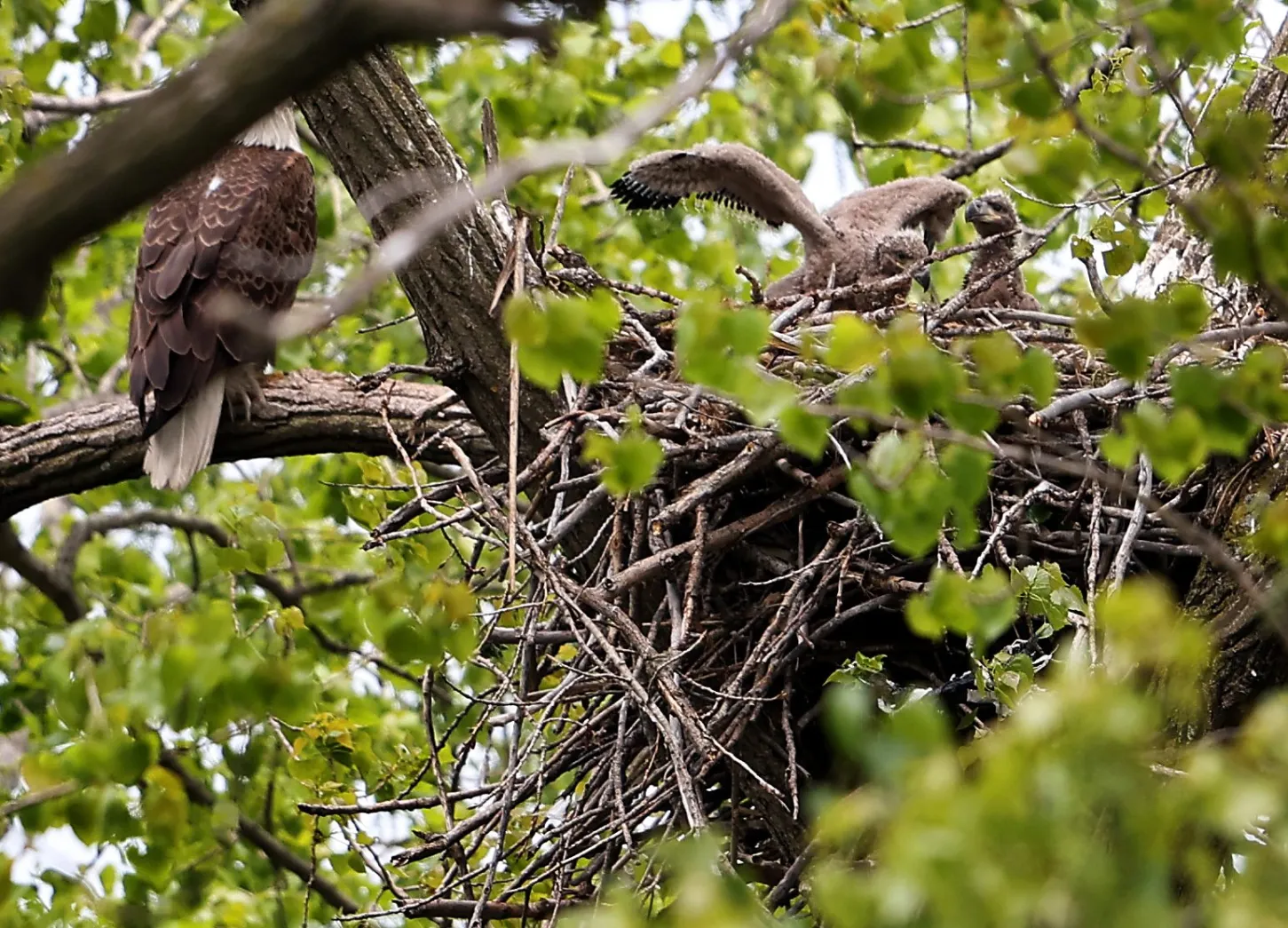
Migizi and Marian, two of the three eaglets born in Chicago earlier this year in their nest, with one of their parents watching from a branch next to the nest. After hatching, it takes eaglets 10-13 weeks to fully develop and fledge from the nest. Photo by Chris Sweda.
From an abundant population historically spread throughout the continent to being threatened with near extinction until becoming protected and rebounding as a flourishing species, the perseverance of Bald Eagles is a story of conservation success, one that has seen these phenomenal birds of prey return to Chicago as permanent nesters. The preservation of Bald Eagles inspires many in Chicagoland and beyond to continue advocating for continued conservation of these raptors, with outreach and education to the public and fellow birders on what we can all do to help Bald Eagles here in this state and in North America, including the National Save The Eagles Day, held annually on January 10.
What can YOU do to help Bald Eagles continue to thrive?
Report the locations of active Bald Eagle nests to the U.S. Fish and Wildlife Service to be added to the database. Contact the Chicago office at: cathypollack@fws.gov
Do NOT share the locations of eagle nests on social media. People unfamiliar with ethical birding may cause the eagles to become stressed and disturbed, possibly resulting in them abandoning the nest.
Give eagles space when they're nesting, with a minimum of 660ft between you and the nest. It is ILLEGAL to disturb a Bald Eagle nest.
Bald Eagles are harmed mostly by vehicle collisions, fishing line entanglements, and lead poisoning. Lead left by hunter ammunition and fishing rods can harm eagles when they eat fish, waterfowl, roadkill, and leftover deer gutpiles from hunters. Remember to slow down when driving if you see an eagle on the side of the road eating roadkill. If you fish or hunt in eagle territory, switch to non-lead ammunition and fishing tackle. When fishing, remember to clean up fishing lines and hooks.
Support groups dedicated to the conservation and preservation of Bald Eagles, like the Illinois Audubon Society and the American Eagle Foundation.
Following these guidelines will help ensure that Bald Eagles continue to flourish in Chicagoland for generations to come. The recovery success story of these incredible birds in this region is awe-inspiring and creates feelings of hope and determination. Because of the collective effort of people who cared about the wildlife and environment that surrounds us, the Bald Eagle was able to recover from the threat of extinction, now seen not only as a symbol of bravery and strength, but also of survival and recovery. With the protection acts in place and DDT banned, Bald Eagles have fully recovered and continue to prosper across North America.
So next time you find yourself overlooking a lake or river in the early morning, look up. Watch the trees and sky for a dark brown predatory bird, broad-straight wings gliding in the air with a white-feathered head and tail. If you're patient and know where to look, you may just see a Bald Eagle flying through the Chicago sky once more.

Field Guides and Database
Bald Eagle Field Guide from the National Audubon Society
Bald Eagle Field Guide from the Cornell Lab of Ornithology | Birds of the World
Northern Illinois Bald Eagle Database on eBird
Illinois Department of Natural Resources Information
U.S. Fish and Wildlife Service Information
Bald and Golden Eagle Protection Act
National Bald Eagle Management Guidelines
Forest Service | U.S. Department of Agriculture Information
Bald eagles return to Chicago area: A conservation success story - January 19, 2022
#SaveTheEagleDay Panel Discussion - January 10, 2022
Indigenous Traditions and Beliefs
Indigenous Tribes of Chicago - American Library Association
The Symbolism of Eagles in Indigenous American Traditions: A Cultural Perspective - Study of Symbols
The Thunderbird in Native American Folklore: Mythology, Meaning, and Modern Interpretations - History Defined
Bald eagles and the Thunderbird myth: Birds in pre-contact ceremonialism on Martha’s Vineyard, USA - Quaternary International, March 30, 2020
Additional Resources
Florida Vertebrate Fossils - Haliaeetus leucocephalus - Florida Museum
The American Bald Eagle - Celebrating America’s Freedoms, U.S. Department of Veterans Affairs
The Plumage of a Juvenile, Immature, and Adult Bald Eagle - Avian Report
National Save The Eagles Day - National Today
Bald Eagle nesting in NE Illinois - University of Illinois Urbana-Champaign Prairie Research Institute, June 20, 2012
Eaglet Growth and Development - Elfruler, 2019
What is The Best Time Of Day To See Bald Eagles? Unveiled - Learn Bird Watching, July 20, 2023
The Role of Bald Eagles in Native American Culture - Animals Around the Globe, April 2, 2025
21 Things Most Illinois Residents Never Realize About Bald Eagles - Yard Life, May 26, 2026
Header photo of a Bald Eagle on a nest with a juvenile in Ned Brown Forest Preserve in Cook County, IL by Gary Aleksiak.