
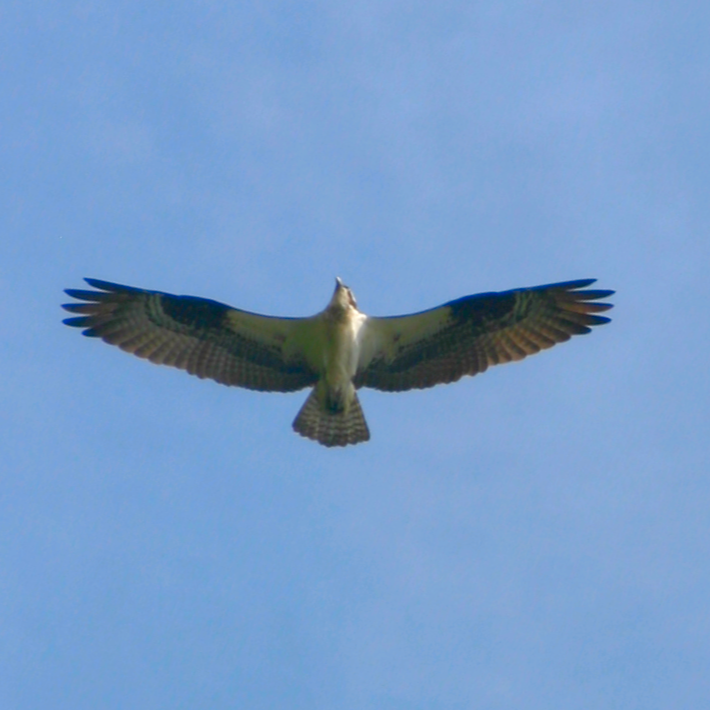
This past April, the Chicago suburb of Lemont celebrated the grand opening of the latest addition to its growing downtown area: Athens Park, provided by the Lemont Park District. Located near the heart of downtown Lemont and running along the I&M Canal and the Des Plaines River, Athens Park represents the past, present, and future of Lemont, from its rich history and growing community to its culture and the surrounding environment. The Lemont Park District, in collaboration with the Army Corps of Engineers and Pizo & Associates, prioritized the importance of native plants for the park by establishing a naturalized wetlands area that surrounds the perimeter of Athens. This wetland area has served as an incredible spot to observe several birds in their natural habitat, including Blue-Winged Teals, Mallards, Double-crested Cormorants, Spotted Sandpipers, Killdeer, and Barn Swallows.
But perhaps the surprise cornerstone of this wetland area, hidden in plain sight, is an active Osprey nest on top of a utility pole, safely beyond the fenced-off wetland area, yet viewable from all angles of Athens Park.
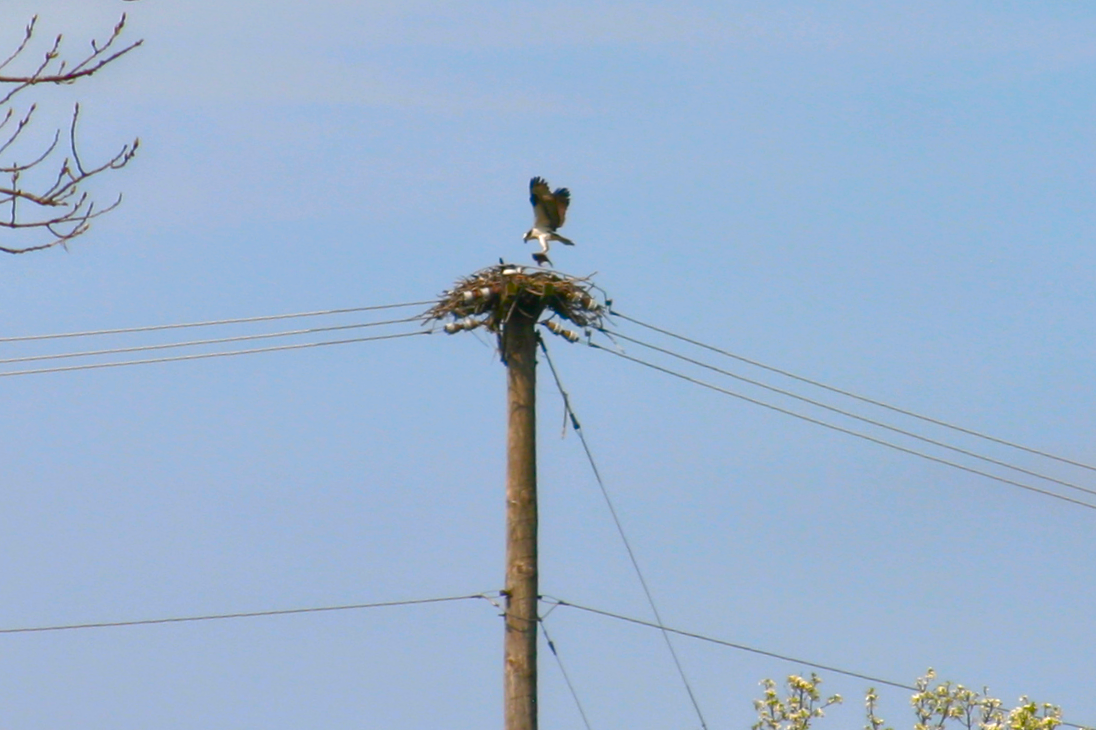
An Osprey returning to its nest with a fish in its talons, viewed from Athens Park in Lemont, IL. During mating season, male Ospreys will bring fish to the female while she roosts. Photo by Joseph Bruno.
The sight of Ospreys nesting in the southern tip of Cook County is both fantastic and not unheard of. As it turns out, this is not the only Osprey nest in Lemont, as another active nest was located not far from Athens Park. This pair was first sighted nesting in Lemont around 2018, originally nesting on top of the Santa Fe Bridge, before building a nest on an electrical tower near Lemont’s Metropolitan Water Reclamation Plant. And in June 2020, Chicago Bird Alliance Board Member John Elliott led a bird walk at Duffy Forest Preserve in Lemont to view an Osprey nest located within the preserve. Even beyond Lemont, Osprey nests have been found in Orland Park and even closer to Chicago, with Ospreys nesting year after year at the Chicago Botanic Garden.
The Osprey, scientifically named Pandion haliaetus, is a migratory bird of prey in Illinois, nesting from the early spring until the beginning of fall, when it migrates south for the winter. They are unique raptors as, despite being commonly referred to as the sea, river, or fish hawk, they are neither hawks nor eagles. On the bird family tree, Ospreys hail from the Accipitriformes order of Pandionidae, and are represented as the sole living member of the genus. Ospreys are also unique in that they have a global population represented by four subspecies: Eurasian Ospreys, Caribbean Ospreys, Australasian Ospreys, and American Ospreys.
With their impressive hunting tactics of diving talon-first for fish and commonly nesting on manmade structures, the presence of Ospreys in Chicagoland is a wonderful sight for birders and ornithologists, but it’s also the result of an important and successful act of ongoing bird conservation. Ospreys were once endangered in Illinois and in the other lower 48 states due to DDT (dichlorodiphenyltrichloroethane) pesticide being used beginning in the 1940s to reduce insect-borne diseases and control insect populations that affect crops and livestock. This, however, resulted in DDT causing toxic and lethal poisoning in the environment and wildlife as it leached into water sources for plants and animals, including Ospreys and other birds. The ingested pesticide weakened their eggshells and resulted in them being crushed by the weight of the roosting parents. When reports of DDT poisoning started to rise in the late 1950s, the U.S. Department of Agriculture started taking regulatory actions, culminating in the U.S. Environmental Protection Agency banning the use of DDT in 1972. By that time, Osprey populations had declined so severely that the Christmas Bird Count (CBC) records from the early 1970s reported that sightings were below 0.60% of total birds seen
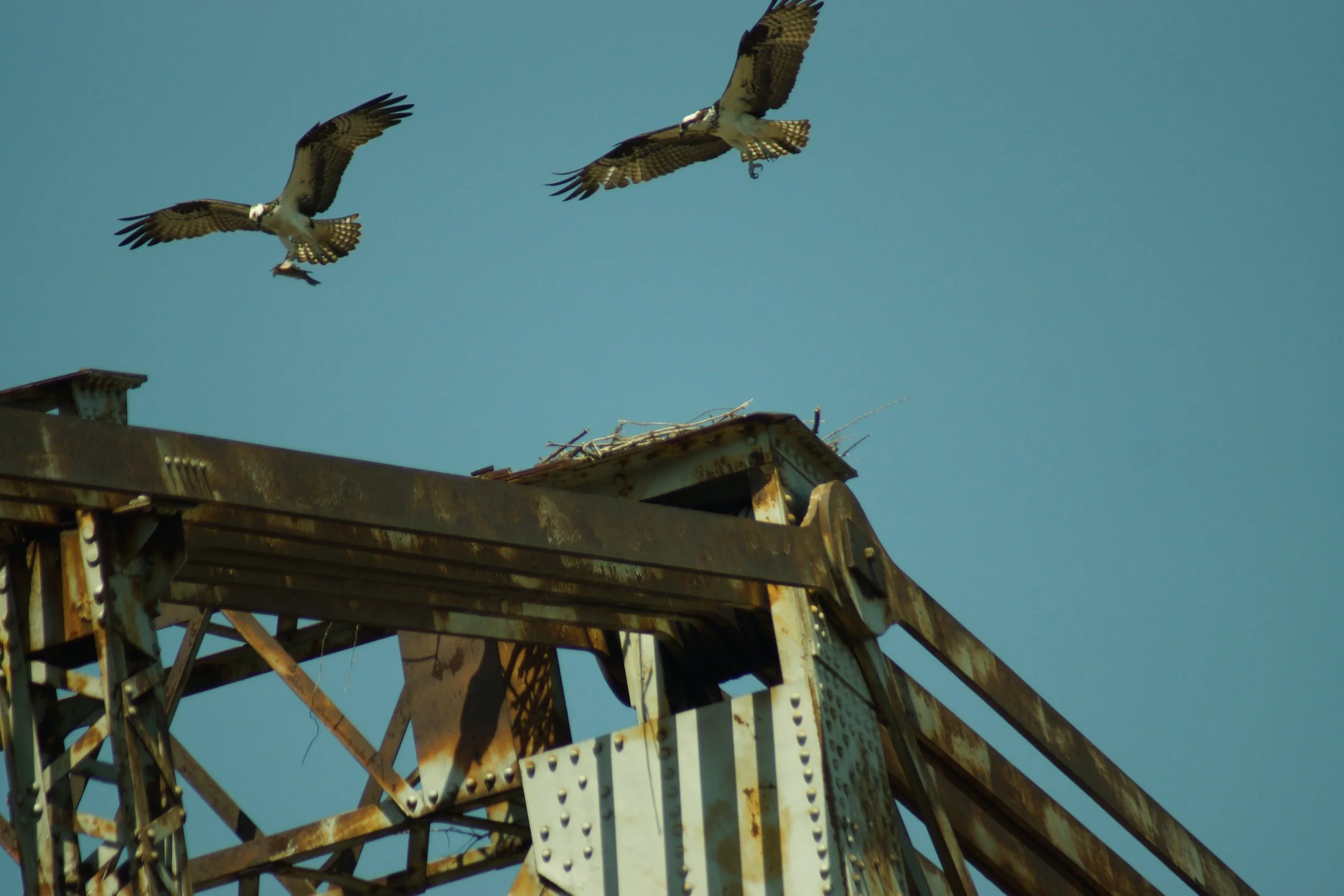
A mating pair of Ospreys flying above their nest on top of the Santa Fe Bridge in Lemont, IL, circa April 2018. While males and females look nearly identical, female Ospreys have a ‘necklace’ of feathers around their neck. Can you tell which one is the female? Photo by John Quinn.
By 2012, Osprey sightings during the CBC had significantly increased to 5.21%, with Ospreys benefiting not only from the banning of DDT but from the protections for another fish-eating raptor also affected by these pesticides - Bald Eagles - with whom Ospreys frequently compete when hunting for fish. Unfortunately, the damage caused by DDT was nearly catastrophic for Osprey populations in Illinois, as these raptors had become uncommon migrants and would rarely breed in the Prairie State by this point in time. While some parts of the country had seen Osprey populations fully recover, particularly on the East Coast in locations like Chesapeake Bay - home to 10,000 breeding pairs and roughly 20% of the species’ global population - other states enacted Osprey recovery programs to help with conservation measures and increase their populations across the country.
In response to the continued low population of these birds, the Illinois Department of Natural Resources (IDNR) set into motion an Osprey recovery program in 2013, known as the Illinois Osprey Hacking Project.

A juvenile Osprey being held by Tih-Fen Ting, outside one of the hack boxes in Lake Shelbyville, IL. Male juvenile Ospreys are usually selected for the Osprey Hacking Project to help establish a self-sustaining population, as males have stronger site fidelity, meaning that they return to the same nesting sites during the breeding season. Photo by Dhairya Dixit/Ting Lab at UIS.
“In terms of how I came to work with Ospreys, it was actually an opportunity presented to me by the Illinois Department of Natural Resources,” said Tih-Fen Ting, Ph.D., from the University of Illinois Springfield (UIS). Currently serving as the Professor of Ecology and Environmental Science and formerly as the Director of the School of Integrated Sciences, Sustainability, and Public Health under the College of Health Science and Technology at UIS, Tih-Fen has been the head of the Osprey Project since 2013, working with students at UIS in her lab on the conservation of state-listed species. Before working with Ospreys, she had previously researched raptors in Northern California with Northern Spotted Owls, Lanyu Scops Owls on Lanyu Island in Taiwan, and Short-eared Owls in Northern Illinois. “At that time, I was actually working with another state-listed species, which was Franklin’s ground squirrels. And my project manager at that time, I think he knew about my raptor background, and he asked me [if I’d be interested in participating in Osprey conservation].”
We had the pleasure of speaking with Tih-Fen back in June about her experience working on the Osprey Project, what the hacking process entails, the ongoing success of the project, and where the project is currently. You can watch the full interview on our YouTube channel below!
When the Osprey Project began, Tih-Fen, her team, and IDNR had looked at similar Osprey recovery programs to get a sense of what would work best in Illinois. Based on what other Midwestern states had done, as well as looking at the research of raptor ecologist Stanley Temple, who established four methods of reintroducing predatory birds, Tih-Fen and IDNR decided the hacking method would be the best course of action. The hacking method involves translocating juvenile raptors from nests of wild species populations to the reintroduction locations.
“So in this case,” Tih-Fen said, “we [translocate] the Ospreys collected from the nests in the wild along the East Coast, [bring] them to central Illinois, take care of them until they are ready to fledge, and then we release them.” After collecting 12 chicks that are six weeks old from the South Coast Osprey Project in Massachusetts, which is run by Mass Audubon, Tih-Fen and her team will bring these young Ospreys to the Illinois Raptor Center in Decatur, IL, where they process and band the chicks. After being processed, the chicks are split into two groups of six individuals each and are brought to the two hacking sites monitored by Tih-Fen and her team.
“Whoever actually works on the Osprey Project definitely has to be dedicated, and really has to pay attention to the well-being of the bird,” said Tih-Fen. At each site, the chicks are placed in a hack box, a treehouse-like structure built to house the Ospreys for roughly two to three weeks. The chicks are fed, observed, and studied by two field technicians. After the two-to-three-week period, the hack box door is opened to allow the young raptors to fledge. Before fledging, one chick from each group is tagged with a satellite transmitter. The Ospreys are tracked and monitored following their fledging and first landing by the field techs. In some cases, the field techs will perform a rescue operation if an Osprey has trouble with its first landing, particularly if it ends up landing in water. This work is to ensure that each juvenile can fledge successfully, allowing it to grow up, migrate, and return to Illinois to breed. In doing so, this will create a constant cycle that would allow Ospreys to flourish in Illinois as they did previously. The Ospreys that are tagged with the transmitter are then monitored during their first migration route to see where they went and to keep track of which individuals from the program return to Illinois to breed. “Over the years,” Tif-Fen said, “We actually are able to learn some of their migration behavior, their stopovers, [and] where they actually end up in Central and South America.”
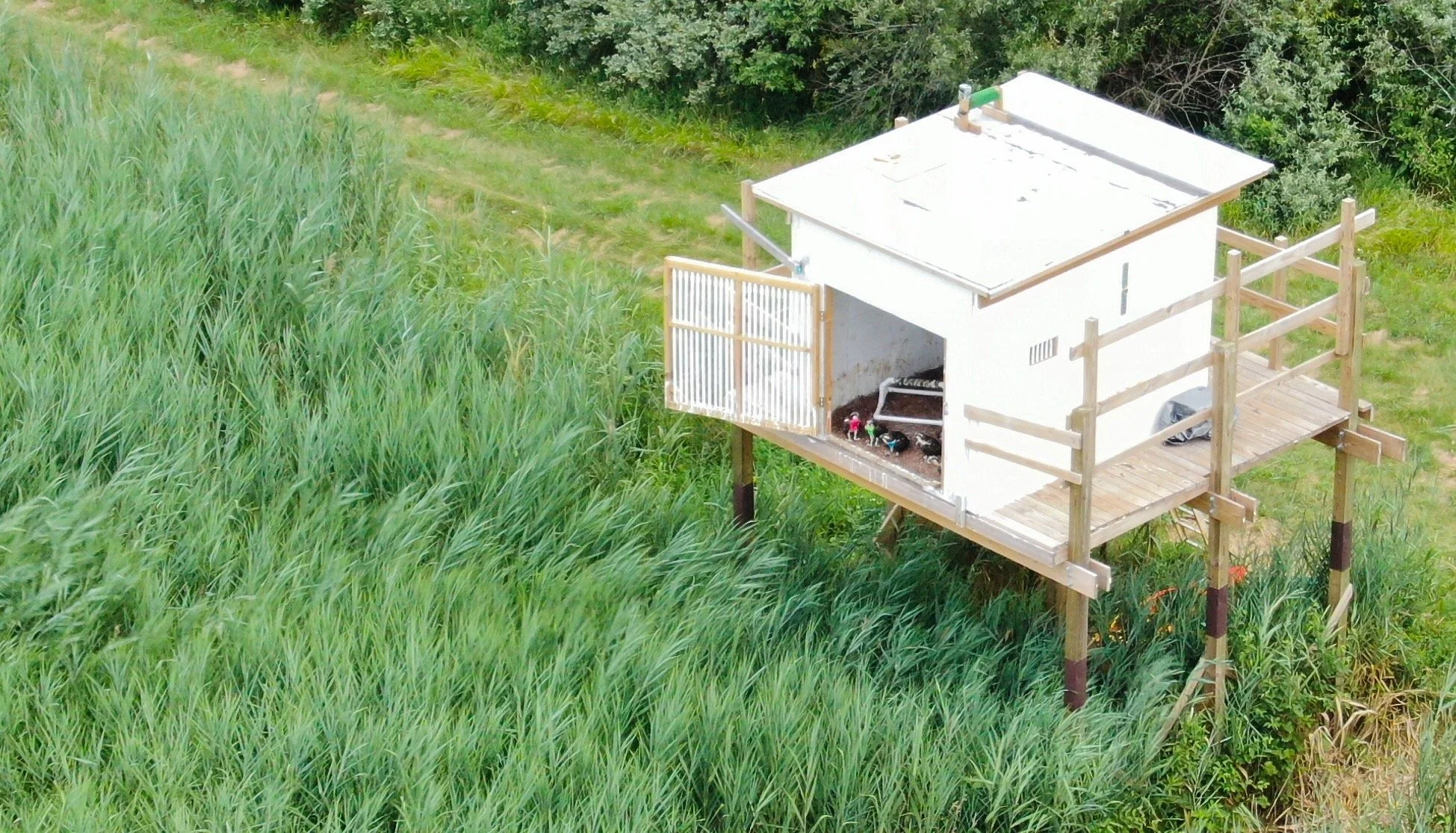
One of the hack boxes used in the Illinois Osprey Hacking Project, with its door open to allow the juvenile Ospreys to fledge. Each Osprey’s chest feathers are painted to help keep track of each individual. Photo by Jack Nuzzo/Ting Lab at UIS.
Since the start of the project in 2013 up until the 2025 season, there have been 142 individual Ospreys hacked so far, with 139 successfully fledging. “Every year, I told my crew,” Tih-Fen said, “when we translocate those birds, we essentially become their foster parents. So while they're still inside the hack box, before they fledge, their wellbeing completely depends on us. Because we still have to feed them, just like their parents would in the field, so we are doing everything we can to make sure that every one of those chicks will fledge successfully.” In 2020, the Illinois Endangered Species Protection Board reviewed the status of the Ospreys. Thanks to the Osprey Project and continued conservation, Ospreys were downgraded from state-endangered to state-threatened.
“The data,” Tih-Fen continued, “was based on the…increasing number of Osprey nests in the state over the years. That was only one piece of information…but that still didn’t tell us about the exact level of recruitment…and so that recruitment [of nests] is actually the data we would need to try to [assess] the viability of the breeding population for the long-term.” In 2025, the next phase of the Osprey Project began with a state-wide nest survey. “While we’re actually…[keeping] the hacking program going, my lab also has built the Illinois Osprey Geodatabase, based on data from the…Natural Heritage Database maintained by the [IDNR], as well as the eBird data or the data from the general public who know how to reach out to us, or the data that we came across from the birding listers.” This information gave Tih-Fen and her team an idea about the number of breeding Ospreys across Illinois, to find out how many juveniles outside of the Hacking Project are fledgling from these nests. Tih-Fen and her team also visit the nests in the geodatabase to verify the number of fledglings produced. The results of this survey would determine whether Ospreys can be fully delisted as a state-threatened species.
This phase of the project will rely on public engagement, with birders observing Ospreys and keeping track of how many juveniles fledge from the nest, which can be done by reporting their findings to eBird or the Illinois Natural Heritage Database run by the [IDNR]. “If folks already know where those Osprey nests are,” Tif-Fen said, “and if they can make sure not to disturb the breeding pairs, they can actually watch from a safe distance, and then be able to actually help confirm the number of fledglings at the end, yeah, that definitely would be wonderful”.
Tih-Fen went on to say that she also welcomes birders and the public to reach out to her to report their Osprey nest sightings. “Over the years, I actually have more people from the general public that came across a new nest,” she said. “They somehow actually found my contact information, and shared with me their findings and observations, and sometimes attached the photos they took of the birds, the chicks, or the nest, and that was wonderful as well.” This is especially helpful as Tih-Fen and her team add to the geodatabase what kind of structure each Osprey nest is built upon.
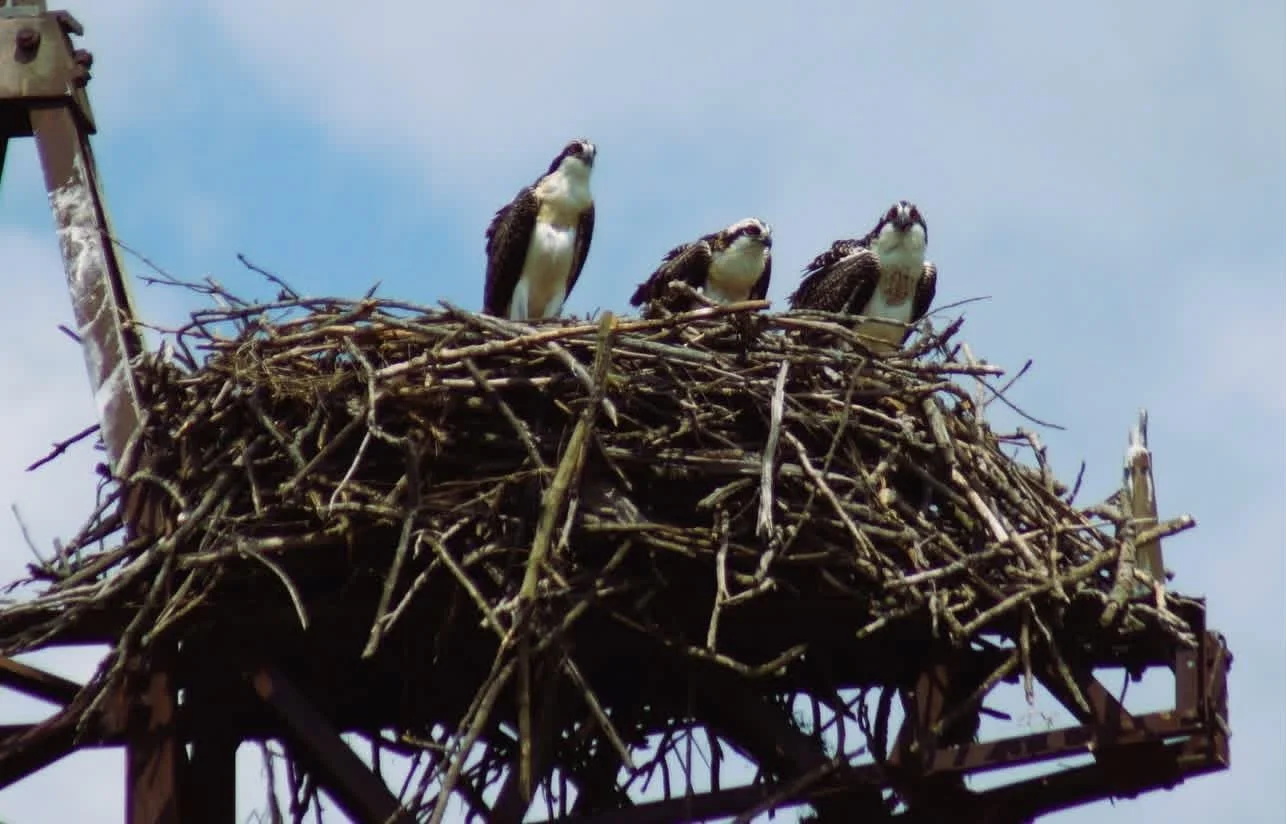
An Osprey nest with chicks overlooking the Metropolitan Water Reclamation District in Lemont, IL. Female Ospreys will have 1 brood per year and lay anywhere between 1 and 4 eggs during the breeding season. The chicks will usually fledge after 50-55 days. Photo by John Quinn.
While the Osprey Project continues with the 2026 season starting not long after we spoke with Tih-Fen, she updated us with some rather startling news: the source population of Ospreys for the Hacking Project is currently suffering from a food shortage for the second year in a row. “I have been concerned about this,” Tih-Fen wrote to us, continuing that she hopes, “it does not develop into a long-term trend similar to what we are seeing in the Chesapeake [Bay].” During the 2023 Osprey research season in the Chesapeake sub-estuary Mobjack Bay, only 17 of the 167 nests visited during that time held live chicks. The rate of the Osprey population in the Chesapeake Bay was beginning to plunge even further than the decline caused by DDT. The population decline goes beyond the Chesapeake Bay, and it isn’t stopping. A report from this summer’s issue of Audubon Magazine shows that the Chesapeake Osprey population is continuing to decline even now. The reason for the sharp and sudden decline across the East Coast? Starvation.
The food source for the Osprey on the East Coast, Atlantic menhaden, is becoming less abundant for Ospreys to hunt and feed to their young due to overfishing, primarily by the company Ocean Harvesters. They deliver the menhaden to be processed by Omega Protein, owned by Cooke Inc., at their plant in Reedville, Virginia. Because of this overfishing, the population of these fish has dropped by 80% since the 1980s. This overfishing disrupts an entire food chain, as many animals in the area depend on menhaden. If Ospreys, an indicator species, are starving, the Chesapeake Bay could be on course for an ecological collapse.
Tih-Fen wrote that “although it was more difficult than usual to secure chicks as robust as those we have had in the past, I believe we are giving them a much better chance of surviving to fledging through our hacking program, where they have access to an abundant and reliable food supply.” While Ospreys in Illinois may continue to flourish, with breeding pairs returning to Chicago and the Hacking Project continuing into its next phase, the starvation of Ospreys on the East Coast remains a very serious problem that must be addressed, especially as it could impact the future of the Hacking Project if chicks become harder to collect.
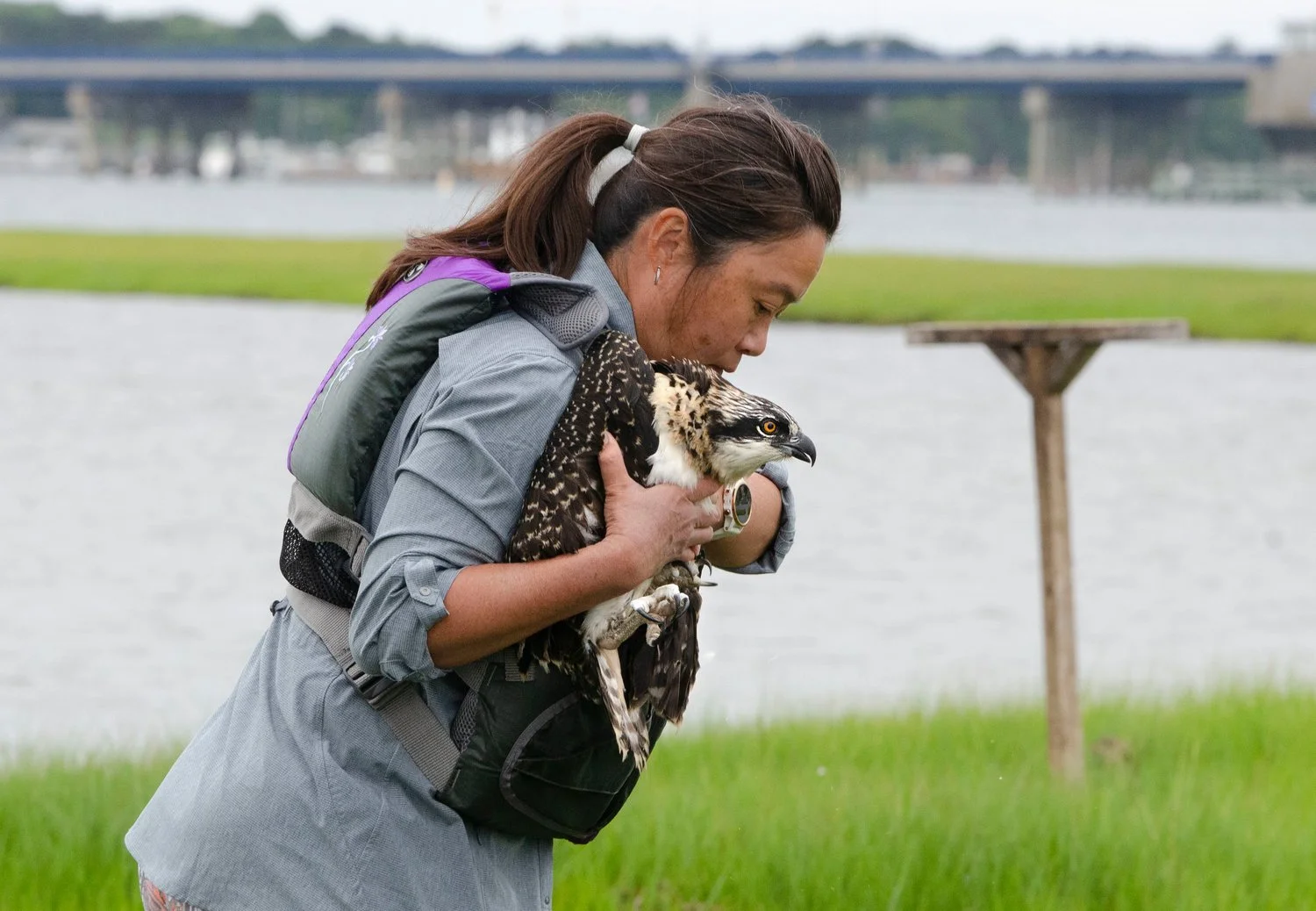
Tih-Fen Ting collects an Osprey chick from the East Coast source population to transport back to Illinois for the Hacking Project. This is just one of several inspiring stories of conservation that show a species can indeed thrive again. Photo by Richard Dionne/Ting Lab at UIS.
“Throughout this project,” Tih-Fen told us, “I actually got to know the people…they will just reach out to me because they paid attention to the Ospreys, you know, and that they enjoyed seeing the Ospreys.” Ospreys represent an incredible story of bird conservation in action. After declining sharply due to DDT, these magnificent birds of prey were placed under protection, yet still been in need of recovery in the state of Illinois. Thanks to Tih-Fen Ting, her team, and IDNR, the Illinois Osprey Hacking Project has helped these raptors rebound enough to remove them from the state-endangered list, with the goal of being fully removed from the state-threatened list in the near future.
With Osprey populations once more in decline on the East Coast due to a food shortage, Tih-Fen reminds us to think about what we all can do to help not only the Osprey, but the environment around us. “I always think about that if we can also just really pay some attention…to the need of other species, and somehow incorporate them [into] the area where we live, where we work, and where we play…if we can just think about how we can actually share the same space, how we can actually share the resources with them…what we're going to gain is probably a very healthy ecosystem for all of us.”
How YOU can participate in the Osprey Hacking Project
If you find an Osprey nest, keep a safe and respectful distance from it and do not disturb the nest. Coming too close to the nest may result in the Osprey becoming stressed and abandoning the nest.
Keep an eye on the nest periodically to see what the Osprey activity may be, e.g., Ospreys occupying/tending to the nest, bringing food to the nest, evidence of eggs and chicks, and juveniles fledging from the nest.
Log and submit your observations on eBird or report the nest and any evidence of breeding (eggs, young, adults bringing food to the nest) to the Illinois Natural Heritage Database, run by the IDNR. Report your observations at the button below or at the following email: DNR.HeritageDatabase@Illinois.gov
Try to include as much information as possible with your submission, including your name, contact information, date, location, what you observed, and photos. Click here to see a full list of what is recommended in your reports and learn more about submitting observations.
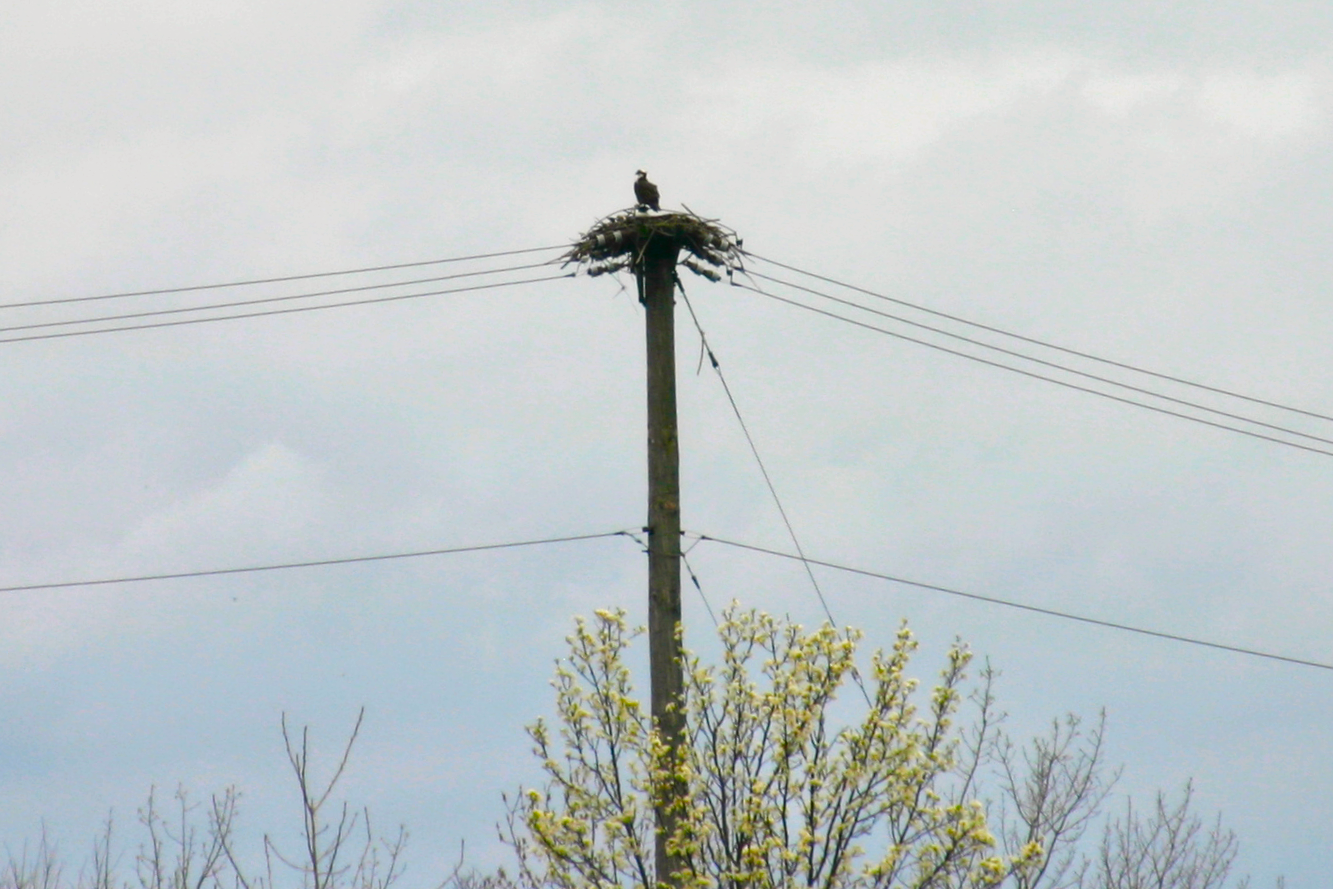
An Osprey looking out from its nest near Athens Park in Lemont, IL. As their population rebounds in Illinois, the future for these raptors on the East Coast remains uncertain. But if we again call for the protection of our wildlife, we may just create a sustainable future for all of us. Photo by Joseph Bruno.
As for the Ospreys on the East Coast, there may be a way to help. The Atlantic States Marine Fisheries Commission (ASMFC) has voted to consider reducing the industrial fishing of menhaden in Chesapeake Bay by 50%. Public comments on this will be accepted until October 10, 2026. Submit a public comment below or email them at: comments@asmfc.org
For more information on Ospreys, the Birds of a Feather Talk Together Podcast, a presenter at the 2026 Urban Birding Festival, has a deep-dive episode on Ospreys, featuring Jack Wildlife (Facebook | Instagram | YouTube Channel).
In addition, Extremely Accurate Bird Songs (The Podcast), the keynote speakers of the 2026 Urban Birding Festival, has an excellent episode on Ospreys with special guest Nick Lund (website).
Learn more about Tih-Fen Ting’s research and lab at UIS
Hacking Ospreys in Illinois - Lewis Hakam, Ting Lab at University of Illinois Springfield, May 6, 2024
Osprey bird population grows in Illinois with help from UIS professor - Blake Wood, UIS News, November 19, 2025
Illinois Department of Natural Resources Information on Ospreys
Report Endangered and Threatened Species
Hacking Project Holds Promise for the Return of the Osprey - Valerie Blaine, Outdoor Illinois Journal, November 2, 2020
The Summer of the Osprey - Part 1 - Carla Rich Montez, Outdoor Illinois Journal, August 3, 2026
The Summer of the Osprey - Part 2 - Carla Rich Montez, Outdoor Illinois Journal, August 3, 2026
Field Guides and Database
Osprey Field Guide from the National Audubon Society
Osprey Field Guide from the Cornell Lab of Ornithology | All About Birds
Information regarding Ospreys on the East Coast
Osprey - Mass Audubon
Researchers Sound the Alarm Over the Chesapeake Bay’s Ospreys - Moria Donovan, Audubon Magazine, May 13, 2024
Ospreys in the Chesapeake Bay Are Starving to Death at Disastrous Rates. What Will It Take to Save Them? - David Gessner, Audubon Magazine, Summer 2026
Help save osprey chicks from starving - Gerald Winegrad, The Baltimore Sun, September 11, 2026
Additional Resources
DDT - A Brief History and Status - US Environmental Protection Agency
Osprey | The Story of Illinois - Illinois State Museum
Creative Platforms Breed Osprey Success - Forest Preserves of Cook County, August 27, 2014
Osprey Q&A - Living with Wildlife - Illinois, January 31, 2022
Ospreys are Nesting! - Friends of the Chicago River, May 4, 2024
Osprey Nests on the Increase in Chicago Region - Tim Balassie, Bird Conservation Network, November 27, 2024
Header photo of a male Osprey flying over Athens Park in Lemont, IL, by Joseph Bruno.