
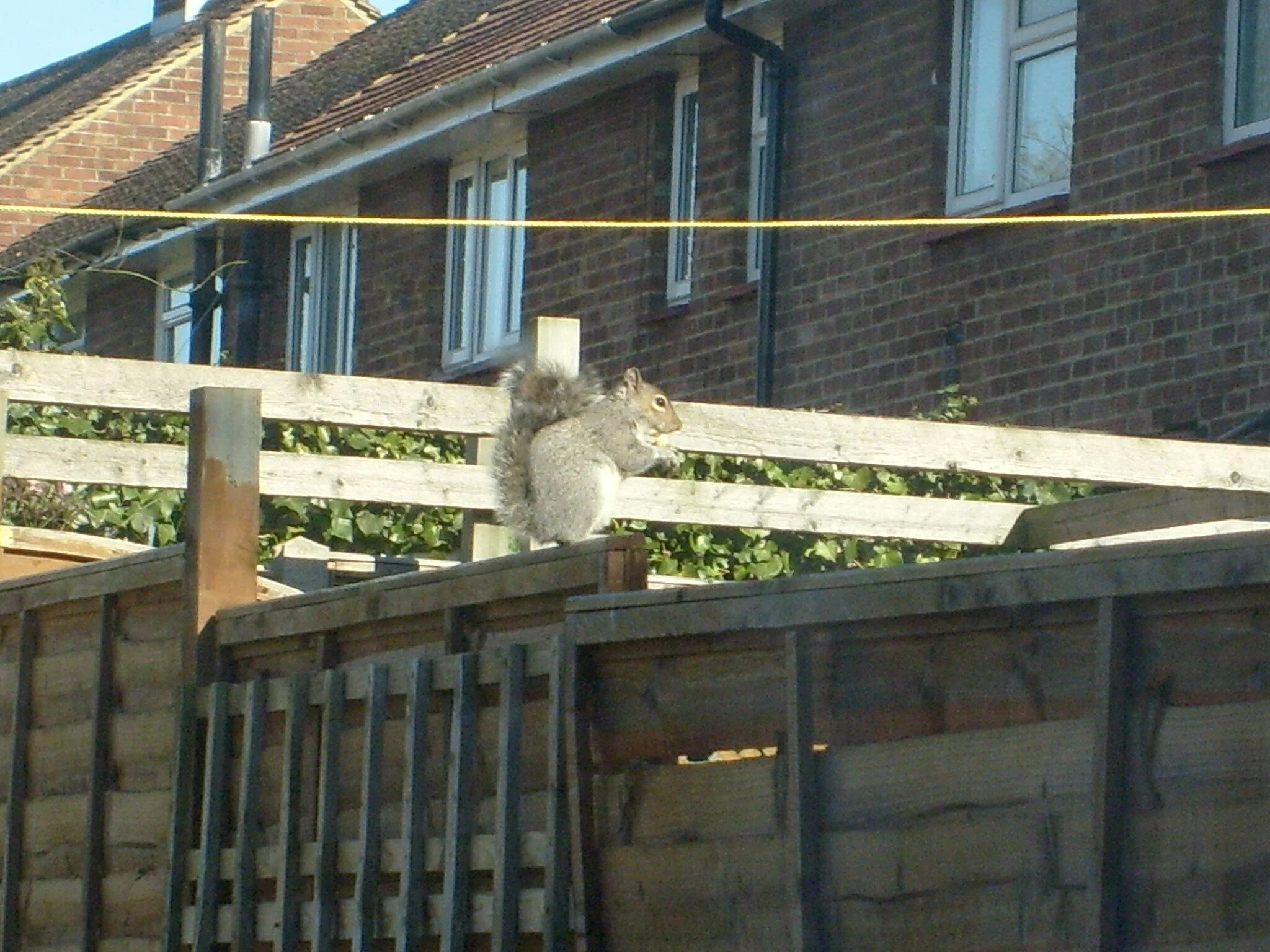
In response to our call for bird questions, Kate R. writes: “In Old Irving Park there must be thousands of squirrels. These squirrels are fat and sassy and running up and down the telephone poles, across the telephone lines and into the trees. Not to mention they run right in front of our cars. If you don't mind the phrase they seem like they are ‘sitting ducks’ for raptors. But while I do see the occasional Cooper’s Hawk, I would think raptors would be feasting on these critters. What gives?”
Great question!
Cooper’s Hawks are indeed urban raptors, and research has found that their numbers are growing in urban settings. It’s thought that the pervasiveness of Rock Pigeons, Mourning Doves, and, sadly (maybe?) our bird-feeders has led to their success. One recent research study examined the winter prevalence during the years 1996-2016 of Accipiter hawks (Cooper’s Hawk and Sharp-shinned Hawk) in… Chicago! During this time period the birds colonized increasingly urbanized areas. “Once established, hawks persisted in areas with high levels of impervious surfaces as long as those areas supported high abundances of prey birds.” The study authors noted other research that finds urban-dwelling Accipiter hawks in North America have a diet containing a large percentage of invasive bird species such as pigeon, European Starling and House Sparrow. Not mentioned – squirrel. Adult squirrels may be too similar in size to be easy prey for these birds, although that doesn’t mean Cooper’s Hawks won’t give it a try.
More frequently reported on eBird by Cook County birders than Cooper’s Hawks, the Red-tailed Hawk does most of its hunting by watching from a high perch, then swooping down to capture prey in its talons. It also hunts by flying over fields, watching for prey below.
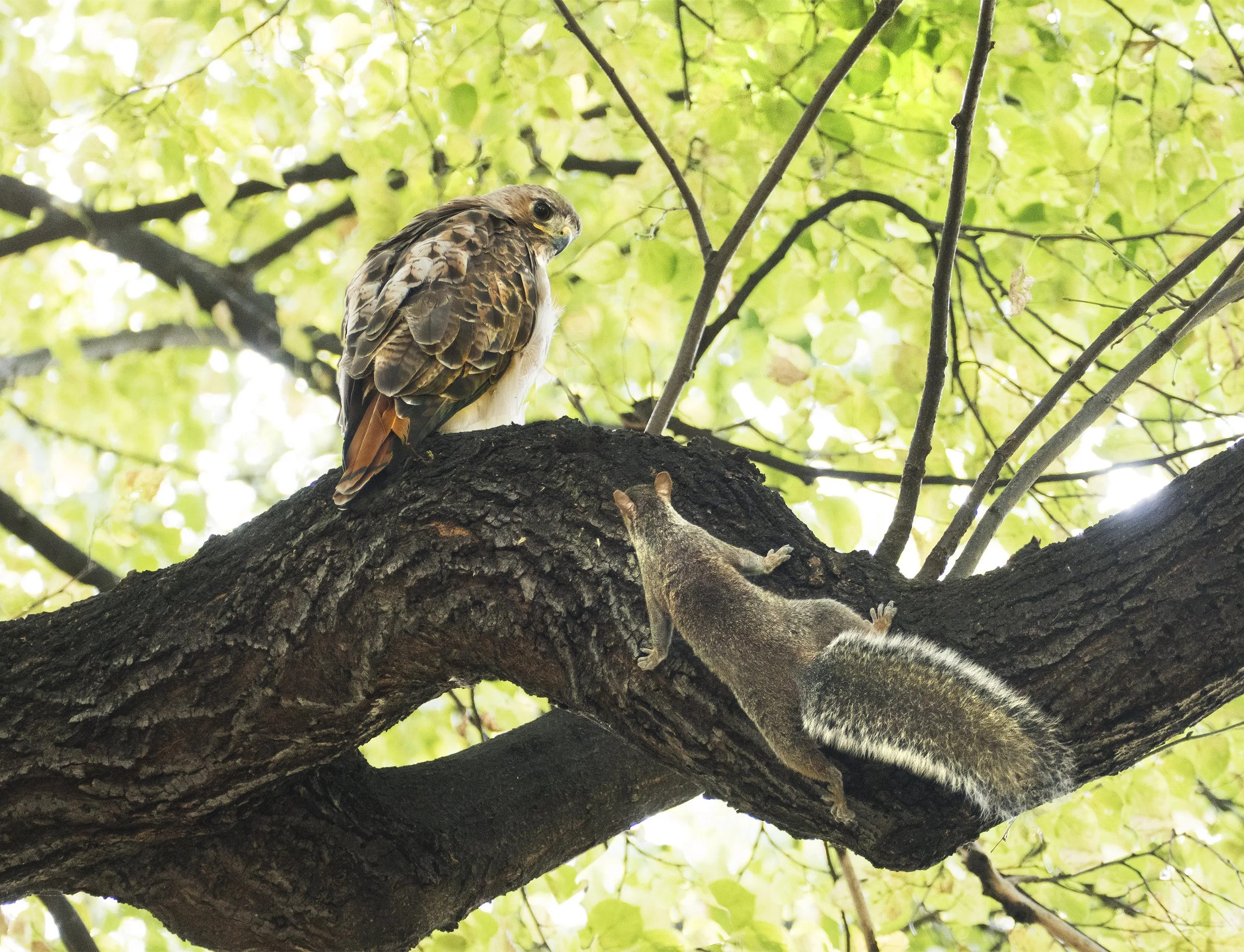
Red-tailed Hawk, Stuyvesant Square, Manhattan, New York
Andrew Garn/Audubon Photography Awards
The larger and bulkier Red-tailed is no doubt a squirrel-hunting pro in our local forest preserves (and indeed, it has been used in falconry for hunting squirrels and rabbits), but it doesn’t have the maneuverability of the Cooper’s in the closer confines of Chicago neighborhoods - or around patio birdfeeder smörgåsbords as this stunning, slow motion video of a Cooper’s Hawk successfully nabbing a meal (or two) shows. Local Red-tailed Hawks may stick to more open, park-like areas, or along our expressways, perched on a utility pole.
Thanks to Kate R. for the question! What have you observed or have been puzzled by that you’d like to understand better? Please send us your bird question here, and we’ll do our best to answer in a future blog.
Sources:
Jennifer D. McCabe, He Yin, Jennyffer Cruz, Volker Radeloff, Anna Pidgeon, David N. Bonter, Benjamin Zuckerberg. Prey abundance and urbanization influence the establishment of avian predators in a metropolitan landscape. Proc Biol Sci 1 November 2018; 285 (1890): 20182120. https://doi.org/10.1098/rspb.2018.2120
Header photo: An Eastern Gray Squirrel in an urban setting